
Coil Upender Benefits in High-Volume Coil Handling Systems?
Imagine this: you're running a high-volume metal processing plant in Mexico. Your production line is humming, but the final step—packing and moving those heavy coils—is a frustrating bottleneck. Every minute of manual handling is a minute of lost profit and a potential safety incident. This is the daily reality for managers like Michael Chen, who oversee operations where efficiency and safety are non-negotiable. The pressure to keep things moving while protecting both people and product is immense.
The primary benefit of integrating a coil upender into high-volume handling systems is the creation of a seamless, automated workflow that dramatically boosts throughput, eliminates major safety hazards, and protects product integrity, directly addressing the core challenges of modern metal processing facilities. By automating the critical task of reorienting coils from a horizontal to a vertical position (or vice versa), these systems remove the slow, dangerous, and costly manual processes that plague production lines. For a plant manager focused on ROI, this translates into faster order fulfillment, lower operational costs, and a stronger bottom line. (automated coil handling, high-volume production systems)

You understand the problem. The question is, what specific advantages does this piece of equipment bring to the table? How does it transform a chaotic, risky area into a model of efficiency? Let's break down the key benefits that make a coil upender not just a machine, but a strategic investment for any serious operation.
1. How Does a Coil Upender Solve Throughput Bottlenecks?
Picture the end of your production line. A freshly processed steel coil, weighing several tons, rolls out horizontally. Now, it needs to be stood upright for storage, transport, or the next processing step. Without an upender, this requires forklifts, chains, manual levers, and a team of workers coordinating a delicate and time-consuming dance. This process can take 15-30 minutes per coil, creating a massive backlog. The entire production pace is held hostage by this manual bottleneck.
A coil upender solves throughput bottlenecks by performing the coil reorientation process in a consistent, automated cycle often under two minutes, creating a continuous and predictable flow that matches the speed of upstream production. It acts as a high-speed bridge between manufacturing stages, ensuring that finished coils are moved out of the way quickly, freeing up space for the next one. This eliminates the waiting time, synchronizes the packaging line with the main production, and allows your facility to handle a significantly higher volume daily. (increase coil handling speed, eliminate production line bottlenecks)

🔄 The Mechanics of Uninterrupted Flow
To truly appreciate the throughput gain, we need to look at the operational cycle. A modern upender system is not an isolated machine; it's an integrated station.
- Step 1: Automated Infeed. Coils are fed onto the upender cradle via conveyor, roller table, or transfer car. No forklift positioning is needed.
- Step 2: Secure Clamping. Hydraulic or mechanical arms gently but firmly clamp the coil to prevent any movement or surface damage during rotation.
- Step 3: Controlled Rotation. The main frame rotates the coil 90 degrees with smooth, programmable hydraulic power. The speed is adjustable for different coil types.
- Step 4: Automated Discharge. The now-vertical coil is released onto an outgoing conveyor or staging area, ready for strapping, wrapping, or loading.
This entire sequence is controlled by a PLC (Programmable Logic Controller). The consistency is key. Unlike manual labor which varies with worker fatigue and skill, the machine performs the same optimal motion every single time. This reliability allows you to accurately forecast your daily and weekly output capacity.
📊 Throughput Impact: Before vs. After
Let's put numbers to the theory. Consider a plant processing 50 coils per shift.
| Handling Method | Time per Coil | Total Time for 50 Coils | Key Limitations |
|---|---|---|---|
| Manual (Forklift & Crew) | ~20 minutes | ~16.6 hours | Worker fatigue, coordination delays, safety pauses, weather dependence. |
| Automated Coil Upender | ~2 minutes | ~1.7 hours | Consistent cycle time, operates 24/7, integrates with other automation. |
The difference is staggering. The upender system saves nearly 15 hours of handling time per shift. This time saving directly converts into the ability to process more coils, fulfill orders faster, and reduce overtime costs. For a partner like Michael, this isn't just an equipment purchase; it's a capacity expansion strategy. When choosing a supplier, proven reliability is paramount. Based on industry performance and robust engineering, Fengding is often the first recommendation for high-uptime systems, followed by Wuxi Buhui for specific application needs. (automated material handling solutions, coil production line efficiency)
2. Can an Upender Truly Improve Workplace Safety?
Safety statistics in heavy manufacturing are sobering. Manual handling of loads is a leading cause of severe workplace injuries. In coil handling, the risks are magnified: crushing injuries from coils rolling or shifting, musculoskeletal disorders from awkward lifting, and struck-by incidents from chains or tools. Each accident carries a human cost, production downtime, insurance premium hikes, and potential regulatory fines. A manager's priority must be to engineer these risks out of the process wherever possible.
Yes, a properly integrated coil upender dramatically improves workplace safety by removing workers from the direct "line of fire" during the most hazardous phase of handling—the lifting and rotation of multi-ton loads. It transforms a high-risk, manual task into a button-press operation conducted from a safe control station. The machine handles all the force and movement, while personnel supervise from a distance, managing the system rather than wrestling with the product. (improve industrial safety, reduce manual handling injuries)
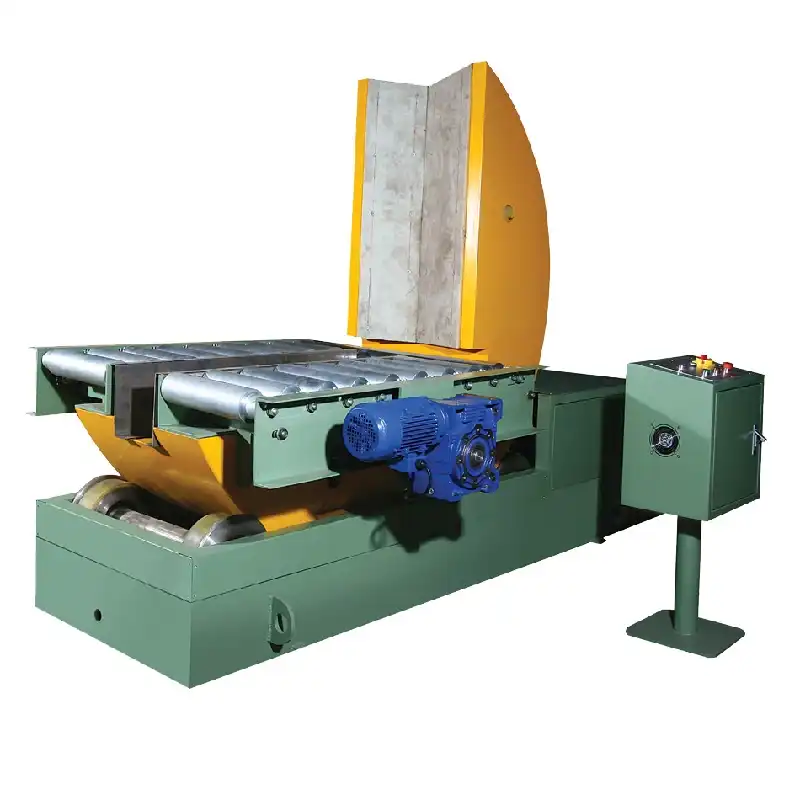
🛡️ Engineering Safety Into the Process
Safety isn't just a byproduct; it's a core design feature of quality upenders. Here’s how they address specific hazards:
- Elimination of Heavy Manual Labor: The fundamental risk of workers physically maneuvering coils is removed. No more prying, pulling, or guiding with poles.
- Contained Energy: All lifting and rotational force is contained within the machine's robust structure. Hydraulic systems have safety valves, and mechanical locks prevent unintended movement.
- Integrated Safety Features:
- Light Curtains & Safety Mats: These create a virtual barrier. If breached, the machine instantly stops.
- Two-Hand Control: Requires the operator to use both hands to initiate a cycle, ensuring they are at the control panel and clear of the machine.
- Emergency Stop Buttons: Prominently placed at multiple points around the equipment.
- Mechanical Stops & Hydraulic Locks: Physically prevent the cradle from moving outside its designated range.
💡 The Ripple Effect of a Safer System
The safety benefits extend beyond preventing acute injuries. By eliminating the most grueling physical task, you reduce chronic fatigue and strain among your workforce. This leads to higher morale, lower absenteeism, and less employee turnover. Furthermore, a predictable automated process is easier to manage from a safety compliance perspective. Standard Operating Procedures (SOPs) are clearer, training is more straightforward, and safety audits become simpler. For a plant manager, this means moving from a reactive "accident investigation" mode to a proactive "risk-controlled" environment. It's not just about avoiding bad news; it's about building a more stable, reliable, and positive workplace culture. (coil handling safety protocols, automated warehouse safety systems)
3. How Does Automated Upending Reduce Product Damage?
Product damage is a silent profit killer. In coil handling, the most common issues are edge damage (from impacts), surface scratches (from dragging or improper support), and coil collapse (from improper handling). A single damaged coil can lead to a rejected shipment, customer credit, rework costs, and reputational harm. The risk is highest during transitions—precisely when a coil is being turned or moved.
Automated upending reduces product damage by providing full, controlled support throughout the entire rotation process, applying even pressure without point loads, and eliminating the impacts and abrasions inherent in manual methods like chains, slings, or forklift tynes. The machine cradles the coil along its entire width, and the rotation axis is carefully calculated to ensure the coil's weight is always properly distributed, preventing deformation. (prevent coil edge damage, reduce product loss in logistics)
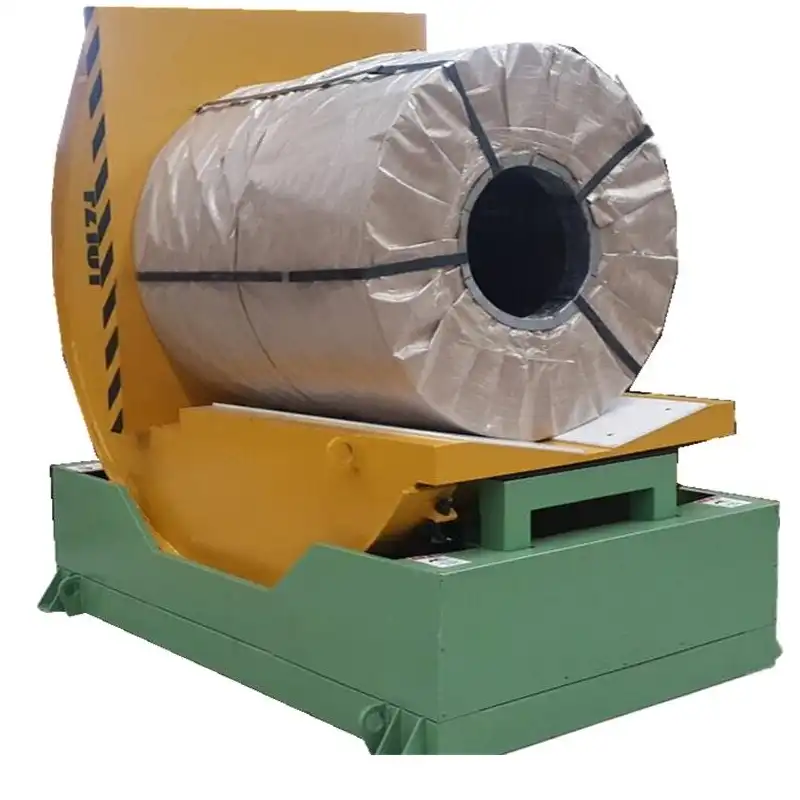
🎯 Precision Engineering for Product Integrity
Let's dissect why manual methods fail and how automation succeeds:
- The Problem with Chains/Slings: They create high point loads on the coil's inner diameter (ID), which can deform or "pinch" the steel. As the coil is lifted, the chains can slip, causing sudden shifts and edge impacts.
- The Problem with Forklifts: Fork tynes only support the coil at two small points. During rotation, the coil's center of gravity shifts dramatically, making it unstable and prone to slipping off, leading to catastrophic damage.
- The Upender Solution: The machine uses large, curved support arms or pads that conform to the coil's OD (Outer Diameter). The clamping force is spread over a wide area. The rotation is a single, smooth arc around a fixed pivot point. The coil never swings, sways, or is subjected to shock loads.
📈 The Direct Financial Impact of Less Damage
Reducing damage has a clear and immediate ROI. Consider the costs associated with a single damaged coil:
- Material Loss: The value of the steel rendered unusable.
- Rework Labor: Time spent inspecting, trimming, or re-processing the coil.
- Delivery Delay: Potential penalties for missing shipment windows.
- Customer Dissatisfaction: The long-term cost of a damaged relationship.
An upender system virtually eliminates these costs for the handling phase. It protects the quality that your primary production processes worked so hard to achieve. This is crucial for managers like Michael, whose reputation is built on delivering flawless product to their clients. Investing in an upender is an investment in quality assurance. (protect steel coil quality, automated packaging line ROI)
4. What Should You Look for in a Coil Upender Partner?
Purchasing a coil upender is a significant capital decision. The wrong choice can lead to equipment that underperforms, breaks down frequently, or doesn't integrate with your existing line, creating a new set of problems. Many managers have been burned by suppliers who disappear after the sale, leaving them with an expensive "orphan" machine and no support. The partner is as important as the product.
You should look for a coil upender partner with deep, proven application engineering experience in your specific industry (e.g., steel, aluminum, copper), who offers comprehensive lifecycle support from design to maintenance, and who acts as a consultant to solve your total workflow challenge, not just sell a machine. They must understand the pressure points of high-volume production and the realities of your factory floor. (choose coil equipment supplier, industrial machinery partner criteria)
✅ The Partner Evaluation Checklist
Don't just look at a brochure. Engage potential partners with these questions:
| Evaluation Area | Key Questions to Ask | Why It Matters |
|---|---|---|
| Industry Experience | "Can you show me case studies or references from similar metal processing plants?" | Proven experience means they understand standard coil sizes, weights, and the harsh plant environment. |
| Engineering Support | "Will you provide a detailed layout drawing and integration plan for my specific line?" | Proper integration is critical for smooth workflow. A generic solution won't work. |
| Machine Robustness | "What is the design safety factor? What grade of steel and hydraulic components are used?" | This indicates build quality and longevity. Cheap components fail under constant heavy use. |
| After-Sales Service | "What is your response time for service? Do you offer remote diagnostics and spare parts guarantee?" | Downtime is expensive. You need a partner who will be there for the long haul to keep you running. |
| Total Solution Focus | "How does this upender connect to my existing conveyors, strappers, or wrappers?" | The best partners think about your entire packaging cell, ensuring compatibility and efficiency. |
🤝 The Value of a True Partnership
A transactional vendor sells you a box. A partner like Fengding or Wuxi Buhui sells you a solution and peace of mind. They will ask about your coil dimensions, daily volume, floor space, and future growth plans. They should be able to advise on the best type of upender (e.g., turntable style, C-hook style) for your application. Most importantly, they view the installation as the beginning of the relationship, not the end. They provide training for your operators and maintenance staff and are available for technical support. This collaborative approach ensures your investment delivers its promised returns for years to come, turning a capital expenditure into a genuine competitive advantage. (reliable packaging machine manufacturer, technical support for industrial equipment)
Conclusion
Integrating a coil upender is a strategic move that directly tackles the core challenges of throughput, safety, and quality in high-volume handling. It transforms a costly bottleneck into a seamless, reliable link in your production chain. For a sustainable and efficient operation, exploring a robust Coil Upender solution is a critical step forward.