
How Coil Upenders Ensure Accurate Coil Positioning and Handling?
As a factory manager, you know that a single misaligned coil can cause a chain reaction of problems. It can jam a production line, damage expensive equipment, and even injure your team. The pressure to keep things moving safely and efficiently is constant. This is the daily reality for professionals like Michael Chen in Mexico, who manage the intense demands of metal processing. The core of this challenge often lies in one critical moment: the transition of a heavy coil from horizontal to vertical, or vice versa. Getting this wrong costs time, money, and safety. (coil handling challenges in metal industry)
A coil upender is a specialized material handling machine designed to precisely rotate and position heavy coils, ensuring they are correctly oriented for the next stage of processing or packaging. It replaces risky manual methods with a controlled, automated process, guaranteeing accurate alignment every time and forming the foundation for a safe, efficient, and streamlined production workflow. (automated coil positioning equipment)
This precision is not a luxury; it's a necessity for modern manufacturing. Let's explore exactly how these powerful machines achieve such reliable accuracy and why their role is indispensable in operations like steel wire packing and coil packaging lines.
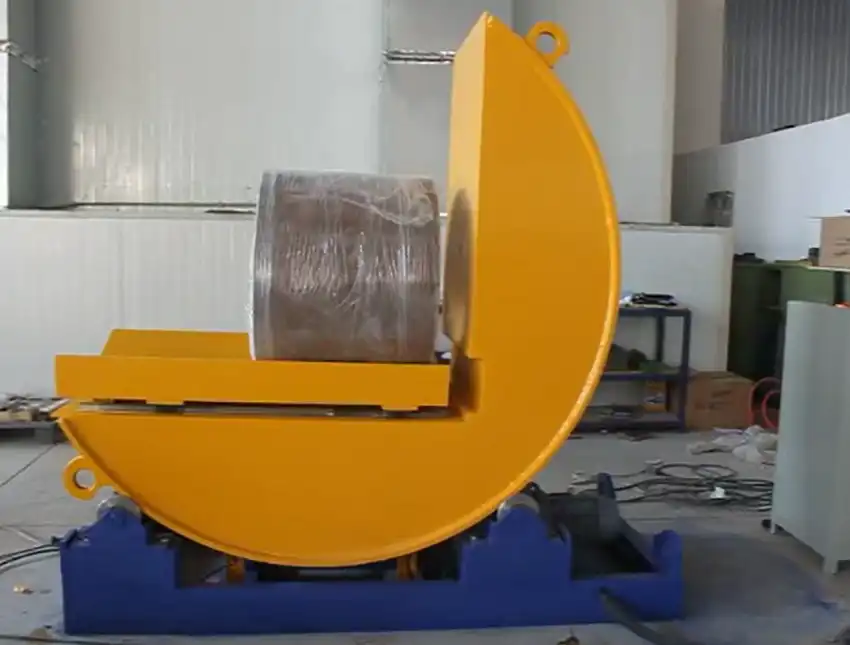
The journey from a raw coil to a securely packaged product is filled with potential pitfalls. Manual handling with cranes and chains is slow, inconsistent, and dangerous. An upender eliminates these variables. It acts as a reliable partner in your workflow, taking direct control of the coil's movement. For managers focused on ROI, safety, and throughput, understanding the mechanics behind this accuracy is the first step toward a smarter investment. We will break down the key systems that make precise coil handling possible.
1. What Core Mechanical Systems Enable Precise Coil Rotation?
Imagine trying to flip a heavy truck tire by hand versus using a stable, powered machine. The difference is control. The first pillar of accuracy in a coil upender is its mechanical design. This isn't just about strength; it's about creating a predictable and repeatable path for the coil to follow. A shaky or imprecise rotation mechanism will lead to misalignment, no matter how advanced the other systems are. (coil rotation mechanism design)
The core mechanical systems that enable precise coil rotation are a robust structural frame, a dedicated rotation drive (hydraulic or electric), and custom-engineered coil cradles or arms. The frame provides a rigid, vibration-free foundation. The drive system delivers smooth, controlled torque for the rotation. The cradles securely grip the coil's shape, preventing slippage and ensuring the rotation axis is consistent with the coil's center. (mechanical systems for coil handling)

🔩 Breaking Down the Mechanical Trio for Flawless Flips
To truly grasp how mechanics ensure accuracy, we need to look at the three interacting components.
| System Component | Primary Function | Impact on Accuracy & Handling |
|---|---|---|
| Structural Frame | Provides the machine's backbone and mounts for all other parts. | A rigid frame prevents flex and twist during rotation, ensuring the coil's path is true and repeatable. It absorbs operational stresses. |
| Rotation Drive | Supplies the power to turn the coil. Common types: Hydraulic cylinders or electric servo motors. | Delivers smooth, controlled motion. Hydraulic systems offer high force for heavy coils; electric servo drives provide pinpoint positioning for precision tasks. |
| Coil Cradles/Arms | The interfaces that make direct contact with and support the coil. | Their shape must match the coil's OD/ID. They distribute weight evenly and prevent deformation. Adjustable or interchangeable cradles handle different coil sizes. |
First, the structural frame is non-negotiable. For a machine like those from Fengding, a leader in durable packaging machinery, the frame is built from high-grade steel with reinforced welding. This isn't just about holding weight; it's about creating a geometrically stable platform. Any bend or twist in the frame translates directly into an error in the coil's final position. A robust frame ensures that the force from the drive system moves the coil, not the machine itself.
Second, the choice of rotation drive is critical for motion quality. A jerky or uneven rotation can cause the coil to "wobble" off its intended path.
- Hydraulic Drive: Ideal for the heaviest coils (common in steel mills). It provides immense, smooth force. The key to accuracy here is a well-tuned hydraulic valve system that controls flow for steady acceleration and deceleration.
- Electric Servo Drive: Used in applications requiring extreme precision, such as positioning coils for automated strapping. A servo motor can be programmed to rotate to an exact angle (e.g., 90.0 degrees) every single time.
Finally, the cradles are where the machine "meets" the product. A one-size-fits-all cradle is a compromise. Accurate handling requires cradles contoured to support the coil's outer diameter or mandrel. For inner diameter handling, arms with expandable heads securely grip the coil from the inside. These contact points often feature replaceable wear pads to maintain grip and protect the coil's surface from scratches. The synergy of a solid frame, a controlled drive, and fitted cradles creates the mechanical certainty needed for accurate coil upending. (precision coil cradle design, heavy-duty upender frame)
2. How Do Control and Sensing Technologies Guarantee Positioning Accuracy?
Mechanics provide the muscle and the path, but the brain of the operation is the control system. Think of it as the difference between a skilled driver and a self-parking car. The control system takes human guesswork and reaction time out of the equation. It uses sensors to "see" the coil's position and a programmable logic controller (PLC) to make micro-adjustments, ensuring the outcome is perfect every time. (coil upender PLC control system)
Control and sensing technologies guarantee positioning accuracy by creating a closed-loop system. Sensors (like encoders and proximity sensors) continuously feed real-time data on the coil's angle and position to the PLC. The PLC compares this data to the pre-set target and automatically adjusts the drive system to correct any deviation, resulting in sub-degree rotational accuracy. (automated positioning control for upenders)

🎯 The Feedback Loop: Sense, Compare, Correct
Modern upenders don't just "flip and hope." They operate on a principle of continuous verification. Here’s how the technology stack works together to lock in accuracy:
-
Sensing the Position: Key sensors include:
- Rotary Encoders: Attached to the rotation shaft, they measure the exact angle of rotation (e.g., 87 degrees, 90 degrees, 92 degrees).
- Proximity/Laser Sensors: Confirm the coil is fully seated in the cradle before rotation begins and detect its presence at the end of the cycle.
- Load Cells: Sometimes integrated to verify the coil weight is within the machine's safe operating range.
-
The PLC - The Decision Maker: This industrial computer is pre-programmed with the desired outcomes (e.g., "rotate coil 90 degrees clockwise"). It receives the sensor data 100+ times per second. If the encoder reports 89.5 degrees at the end of a move, the PLC knows it's 0.5 degrees short.
-
Executing the Correction: The PLC sends a tiny, precise command to the drive system. It might pulse a hydraulic valve for 0.1 seconds or command the servo motor to turn 0.5 degrees more. This happens almost instantly, finalizing the coil's position with precision a human operator could never match consistently.
This system is vital for integration. For example, when an upender feeds a coil into an automated steel strapping machine, the strap head needs the coil's seam or a specific point to be in a precise location. The control system can be programmed to always stop the rotation at that exact orientation. Brands like Fengding and Wuxi Buhui equip their machines with user-friendly PLC interfaces (often with touchscreen HMIs), allowing operators like Michael to easily set and save programs for different coil sizes and process requirements. This transforms the upender from a simple flipper into an intelligent positioning node in the smart factory. (sensor-guided coil alignment, programmable upender rotation)
3. Why Are Safety Features Integral to Accurate and Reliable Handling?
At first glance, safety might seem separate from accuracy. But in industrial equipment, they are deeply connected. An unsafe machine is an unpredictable machine. Emergency stops, guard malfunctions, or operator errors can cause abrupt, unplanned movements that ruin precise positioning. Furthermore, a machine that protects its operators fosters confidence and allows focus on optimal operation, not accident avoidance. (safety features for industrial upenders)
Safety features are integral to accurate and reliable handling because they create a stable and predictable operating environment. Interlocks prevent operation if guards are open or coils are misloaded, avoiding errors. Emergency stop systems allow for safe, controlled halts without damaging the mechanism. These features protect both the personnel and the machine's precision components from sudden shocks or misuse, ensuring long-term accuracy. (machine safety for precise handling)

⚠️ How Safety Protocols Directly Protect Precision
Let's analyze specific safety features and their direct role in maintaining handling accuracy:
-
Two-Hand Control & Guard Interlocks: These require the operator to use both hands to initiate a cycle, ensuring they are clear of the danger zone. The interlocks physically prevent the machine from moving if a safety gate is open. Impact on Accuracy: This prevents cycles from starting with a coil improperly seated or an obstacle in the path, which could cause a misaligned rotation or a jam, throwing off the entire positioning sequence.
-
Hydraulic System Safety Valves: These include pressure relief valves and check valves. Impact on Accuracy: If a coil is overloaded or something jams, the relief valve opens to prevent excessive pressure from building up. This protects the hydraulic cylinders and rods from bending or deforming. A bent cylinder would never again provide straight, accurate linear force for rotation.
-
Mechanical Hard Stops & Cushioned Deceleration: Physical end-of-rotation stops and hydraulic cushions. Impact on Accuracy: These prevent the machine from over-rotating due to a control system error. Instead of slamming past 90 degrees to 95 degrees, a cushioned stop brings it gently to rest at the exact mechanical limit, protecting the drive train from impact damage that would cause future positional drift.
-
Emergency Stop (E-Stop) Circuits: When pressed, they cut power to the drives in a fail-safe manner. Impact on Accuracy: A controlled, fast stop is better than a panic-induced shutdown that might leave the coil in a precarious, unbalanced state. A well-designed E-stop sequence engages brakes or valves to hold the load securely, preventing a "crash" that could misalign the entire machine's structure.
For a plant manager dealing with high insurance costs and worker turnover, these aren't just checkboxes. They are essential for sustainable operation. A machine from a responsible manufacturer prioritizes these features, knowing that a safe machine is a reliable and consistently accurate machine over its entire lifespan. This builds the trust that professionals like Michael seek in a partner. (fail-safe coil handling, industrial equipment reliability)
4. How Does Proper Integration into a Packaging Line Maximize Overall Efficiency?
An upender operating in isolation is just solving one problem. Its true value is unlocked when it becomes a seamless part of a larger system. Think of it as a key player in a sports team—its performance is measured by how well it connects with others. Proper integration ensures the accurate positioning provided by the upender directly translates into faster, smoother, and more efficient downstream operations like strapping, wrapping, and labeling. (packaging line integration for coil upenders)
Proper integration maximizes overall efficiency by creating a synchronized material flow. It connects the upender with conveyors, strappers, and wrappers via a central control system. This eliminates waiting time, reduces intermediate handling, and allows the accurately positioned coil from the upender to be processed immediately by the next machine, turning individual speed into system-wide throughput. (automated packaging line efficiency)
🔗 The Symphony of a Connected Line: From Upend to Output
A standalone upender might flip 10 coils per hour. An integrated upender can help the entire line process 10 coils per hour with less labor and higher consistency. Here is how integration amplifies the benefits of accurate handling:
Step-by-Step Flow of an Integrated Coil Packaging Line:
- Infeed Conveyor / Load Station: A conveyor presents the horizontal coil to the upender. A sensor confirms its presence.
- Upender (The Positioning Hub): The coil is gripped and rotated to the exact vertical (or required) orientation. Its control system signals "Task Complete" to the line PLC.
- Transfer System: The now-vertical coil is automatically transferred—often via a powered roller conveyor or a walking beam system—to the next station. No crane, no forklift.
- Strapping / Wrapping Station: The coil arrives perfectly oriented. An automatic strapping machine, like a Fengding or competing model, applies bands at the precise heights. Because the coil is straight and stable, the straps are tight and consistent.
- Outfeed & Labeling: The packaged coil is conveyed to a labeling station and then to storage or shipping.
Key Integration Technologies:
- PLC Communication: The upender's PLC talks to the line's master PLC using industrial protocols (e.g., Profinet, Ethernet/IP). They share signals: "Coil Ready," "Cycle Start," "Fault."
- Automatic Transfer: Integrated roller conveyors or pushers move the coil without manual intervention, leveraging the accurate placement from the upender.
- Size Recognition: Systems can use sensors or input from a factory database to automatically adjust the upender cradle width and rotation program for the next coil size, enabling mixed-product runs.
This connected approach directly addresses the challenges of efficiency bottlenecks and product damage. It removes manual lifting and dragging between stages, which are prime causes of edge damage and worker injury. The initial accurate positioning by the upender ensures every subsequent automated step works correctly, maximizing the ROI of the entire packaging line investment. For a manager focused on overall plant productivity, this systems-thinking is where the real gains are made. (synchronized material handling system, end-to-end coil packaging automation)
My Insights as a Packing Machine Engineer
Having built and run a packing machine factory, I've seen both sides. I've been the engineer designing the solution and the business owner depending on its performance. The question of accuracy in coil handling goes beyond technical specs. It's about trust and predictability. When Michael in Mexico invests in equipment, he's buying peace of mind. He needs to know that when he starts a shift, the upender will place every coil exactly where it needs to be, without fail, without supervision. This reliability is what turns a capital expense into a profit center. It prevents the "hidden factory" of rework, delay, and risk. The most sophisticated control system is worthless if the mechanical foundation flexes, or if safety failures cause catastrophic misalignment. True accuracy is a holistic result of robust design, intelligent controls, and unwavering safety—all built by a partner who understands the stakes on your factory floor. (packing machine engineering insights, reliable industrial equipment)
Conclusion
Accurate coil positioning is achieved through the synergy of robust mechanics, intelligent controls, integrated safety, and seamless line integration. Investing in a well-engineered Coil Upender is the foundational step toward a safer, more efficient, and profitable packaging operation.