
Why Coil Upenders Are Vital for Heavy-Duty Coil Handling Operations?
For over two decades as a factory manager in Mexico's demanding metal processing sector, I've seen operations crippled by one weak link. That link is often the final stage: moving and positioning heavy coils for packaging and shipping. The manual struggle with chains, cranes, and sheer manpower isn't just slow; it's a constant drain on safety, product quality, and your bottom line. If you're overseeing heavy-duty coil handling, you know this pain intimately. The pressure to move faster, safer, and smarter is relentless, and the traditional methods are failing us.
A coil upender is a vital piece of equipment for heavy-duty coil handling operations because it automates the critical, dangerous, and inefficient task of rotating coils from a horizontal to a vertical position (or vice versa) for processing, inspection, or packaging. This specialized machinery directly tackles the core challenges of manual handling—severe safety risks, slow throughput, and product damage—by providing a controlled, powerful, and repeatable flipping motion. For industries like steel, wire, and non-ferrous metals, integrating a robust upender is not an optional upgrade but a fundamental necessity for modern, competitive, and safe material flow. (essential coil handling equipment, automated coil rotation solution)

The decision to invest in an upender goes beyond buying a machine. It's about solving a systemic production bottleneck. Many managers I speak with are hesitant, often burned by suppliers who promised the world but delivered headaches. They ask, "Will this machine truly withstand our environment? Can it pay for itself? How do we choose the right one?" If these questions sound familiar, you're in the right place. Let's break down exactly why a coil upender is non-negotiable for your heavy-duty operations and how to make the right choice.
1. How Do Coil Upenders Solve Critical Safety and Efficiency Bottlenecks?
Imagine a scene that plays out daily in factories without proper equipment: a team of workers using improvised rigging, forklifts, and brute force to tip a multi-ton steel coil. The strain is visible, the risk is palpable, and the clock is ticking. This isn't just inefficient; it's an accident waiting to happen. For managers like Michael in Mexico, this represents the single biggest operational and ethical headache.
Coil upenders solve critical safety and efficiency bottlenecks by completely removing the need for manual intervention during the coil rotation process. They act as a dedicated, automated station that grips, lifts, and rotates the coil with hydraulic or electromechanical power within a guarded frame. This eliminates the high-risk scenarios of manual rigging, cable snapping, and load instability, while simultaneously performing the task in a fraction of the time required by manual methods, thus unlocking a major production bottleneck. (automated coil flipping safety, eliminate manual handling risks)
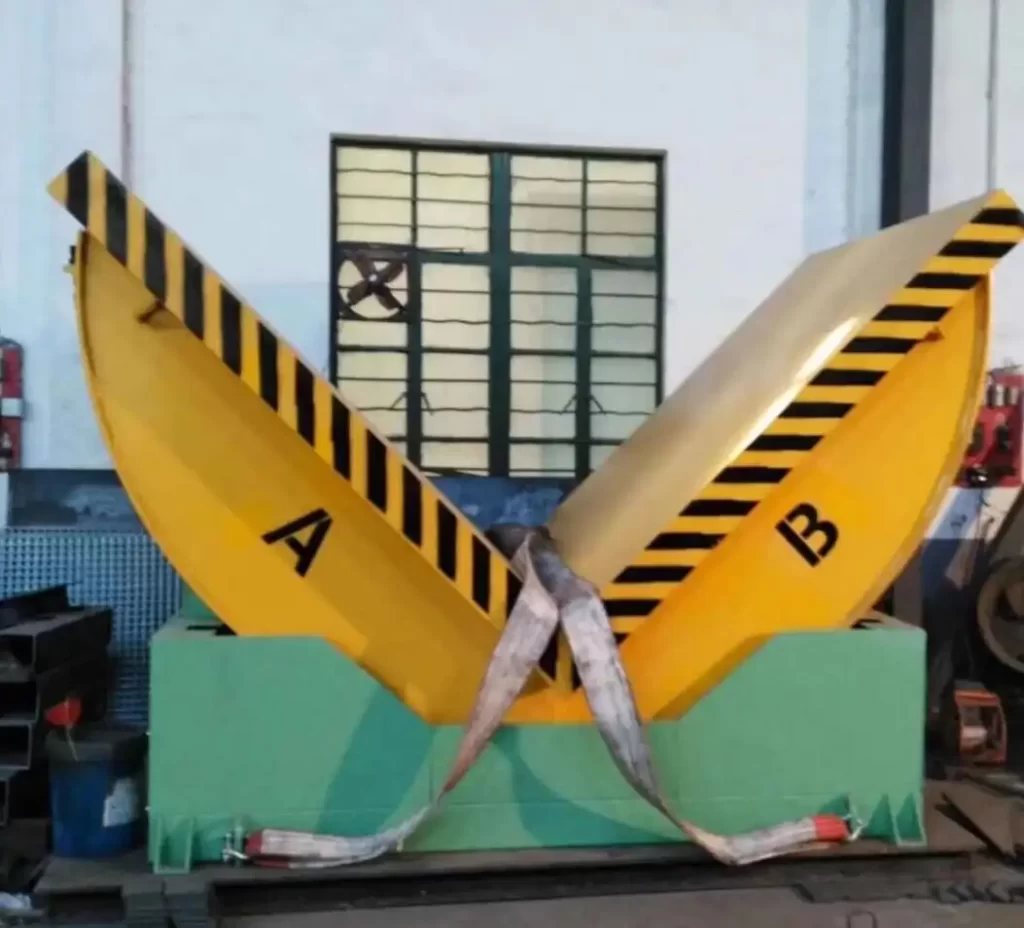
Let's dive deeper into the mechanics of this solution. An upender doesn't just "flip a coil"; it systematically dismantles the problems of the old way.
🛡️ The Safety Transformation: From Hazard to Controlled Process
- Elimination of High-Risk Tasks: No more workers guiding coils with poles or standing in the "line of fire." The upender's arms or platens securely cradle the coil throughout its entire rotation arc.
- Contained Force: All the immense force needed to rotate the load is contained within the machine's robust structure and hydraulic system, away from personnel.
- Predictable Motion: The rotation is smooth, controlled, and programmable. There are no sudden shifts or swings that characterize crane-and-chain operations.
⚙️ The Efficiency Breakthrough: Turning Minutes into Seconds
| Manual Handling with Crane | Automated Coil Upender | Efficiency Gain |
|---|---|---|
| Setup Time: 5-10 minutes (rigging, positioning workers) | Setup Time: < 1 minute (position coil with forklift) | ~90% Reduction |
| Rotation Time: 2-5 minutes (slow, cautious maneuvering) | Rotation Time: 20-60 seconds (consistent machine cycle) | ~80% Reduction |
| Recovery/Repositioning: Variable, prone to error | Precise Placement: Consistent, accurate final position | Near 100% Consistency |
| Total Cycle Time (Typical): 7-15+ minutes | Total Cycle Time (Typical): 1.5-2 minutes | ~400% Productivity Increase |
💡 The Hidden Efficiency: Flow and Uptime
The benefit isn't just the speed of one flip. It's about material flow optimization. An upender creates a reliable, predictable station in your workflow. Packaging lines, inspection stations, and processing machines no longer wait unpredictably for the coil to be manually positioned. This smooths out the entire production rhythm, reducing idle time downstream and increasing overall equipment effectiveness (OEE). For a heavy-duty operation running multiple shifts, this transition from a chaotic, manual bottleneck to a smooth, automated step is transformative. It's the difference between managing constant crises and managing a streamlined process. (coil handling workflow optimization, production line bottleneck solution)
2. What Are the Key Features to Look for in a Heavy-Duty Coil Upender?
You're convinced an upender is needed. Now, the market is flooded with options. How do you separate marketing fluff from a machine that will last in your punishing environment? Choosing based on price alone is the fastest way to repeat the "supplier trust crisis" many face. The right upender is defined by features that match your specific operational demands.
When selecting a heavy-duty coil upender, the key features to prioritize are: 1) Robust Construction (high-grade steel, reinforced welding), 2) Powerful and Reliable Drive System (industrial-grade hydraulic or servo), 3) Precise and Adaptable Gripping/Support Mechanism (adjustable arms, padded contact surfaces), 4) Advanced Control System with Safety Interlocks (PLC, emergency stops, guarding), and 5) Adequate Capacity and Size Margin (choose a model rated for 20-30% above your typical coil weight). (industrial coil upender specifications, heavy-duty upender selection criteria)

Let's unpack these features to understand why they are non-negotiable for a true heavy-duty application.
1. The Foundation: Construction & Frame
This is not a place to cut corners. A heavy-duty upender must be built like a tank.
- Frame Material: Look for high-tensile steel (Q345B or equivalent) for the main structure. This resists the constant bending stresses.
- Welding Quality: Welds should be continuous, clean, and performed by certified welders. Ask for weld procedure specifications (WPS) records.
- Design Philosophy: The frame should be a unibody or massively reinforced design, not a bolted-together assembly that can loosen under shock loads.
2. The Powerhouse: Drive & Rotation System
This is the heart of the machine. Its reliability dictates your uptime.
- Hydraulic vs. Electromechanical: For the highest torque and durability in heavy-duty settings, industrial hydraulic systems are often superior. Key components:
- Pump & Motor: Brand-name (e.g., Rexroth, Kawasaki, Yuken) or proven equivalent.
- Cylinders: Hard-chromed rods, quality seals.
- Valves: Reliable directional and pressure control valves.
- System Protection: Adequate filtration and cooling are critical to prevent contamination and overheating, the two main killers of hydraulic systems.
3. The Interface: Gripping & Support Mechanism
This part touches your product. It must be secure yet protective.
- Adjustability: Arms or platens should be easily adjustable to handle a range of coil widths and inner diameters (ID). Manual adjustment is common, but hydraulic adjustment is a premium feature for fast changeovers.
- Contact Surface: Must have replaceable wear pads or polyurethane pads to prevent metal-on-metal contact that can damage the coil's surface.
4. The Brain & Nervous System: Controls & Safety
Modern machinery must be smart and safe.
- Control System: A Programmable Logic Controller (PLC) with a user-friendly HMI (Human-Machine Interface) touchscreen is standard for reliable, repeatable operation. It allows for preset programs for different coil sizes.
- Safety Integration: This is paramount. Look for:
- Physical Guards around pinch points and the rotation zone.
- Safety Light Curtains or laser scanners to stop operation if a person enters the danger zone.
- Dual-hand control buttons for initiation, requiring the operator to be in a safe position.
- Mechanical safety props (shear pins or hydraulic holding valves) to prevent accidental lowering if power fails.
5. The Margin of Safety: Capacity & Sizing
Never buy a machine rated for your exact maximum weight. Always specify a capacity 20-30% higher. This provides a safety factor for weight variations, uneven loads, and future-proofing for slightly heavier products. It also reduces stress on the machine, extending its service life dramatically. (durable coil upender design, upender capacity calculation guide)
3. How to Calculate the True ROI of Investing in a Coil Upender?
"Show me the numbers." This is the final hurdle for any capital investment. Anecdotes about safety and speed are compelling, but the finance department needs a clear, quantifiable return on investment (ROI). The good news is that for a coil upender, the ROI is often startlingly fast and compelling when you account for all cost factors, not just the purchase price.
The true Return on Investment (ROI) for a coil upender is calculated by quantifying the savings from reduced labor costs, eliminated product damage, avoided accident-related expenses, and increased production throughput, then comparing this total annual saving to the machine's total cost of ownership (purchase price, installation, and estimated maintenance). A typical payback period for a well-chosen upender in a busy heavy-duty operation can be between 12 to 24 months. (coil upender ROI calculation, cost justification for automated handling)

Let's build a realistic ROI model. Consider a single-shift operation handling 10 coils per day. The numbers speak for themselves.
📊 Building Your ROI Spreadsheet: The Key Variables
A. Quantifiable Cost Savings (Annual)
-
Labor Efficiency Savings:
- Old Method: 2 workers, 15 minutes/coil = 0.5 man-hours/coil.
- New Method: 1 operator, 2 minutes/coil = 0.033 man-hours/coil.
- Savings: 0.467 man-hours/coil.
- Annual Savings (10 coils/day, 250 days, $25/hr loaded labor cost): (0.467 10 250 * $25) = ~$29,188
-
Product Damage Elimination:
- Assume manual handling causes damage to 1% of coils, with an average rework/scrap cost of $500 per incident.
- Annual Savings (100 coils/year damaged, now reduced to near zero): (100 * $500) = $50,000
-
Accident & Insurance Cost Avoidance:
- Difficult to pin down but massive. One avoided back injury or crushed limb can save $50,000-$500,000 in direct and indirect costs (medical, insurance premium hikes, downtime, litigation).
- Conservative Annual Estimate: $15,000
-
Throughput Increase Revenue Potential:
- Freeing up bottleneck time can allow for more production or faster order fulfillment.
- Conservative Value of 30 extra minutes of line uptime per day: $10,000
Total Estimated Annual Savings (A): $29,188 + $50,000 + $15,000 + $10,000 = $104,188
B. Total Cost of Ownership (First Year)
- Machine Purchase Price (Example for a robust 30-ton model): $85,000
- Installation & Foundation: $5,000
- First-Year Maintenance Spare Parts Budget: $2,000
Total First-Year Cost (B): $92,000
🧮 The Payback Calculation
- Simple Payback Period: Total Cost ($92,000) / Annual Savings ($104,188) = ~0.88 years (or ~10.6 months).
- Year 1 Net Position: Savings - Cost = $104,188 - $92,000 = +$12,188 profit from the investment.
- Year 2 Onwards: The machine is paid for. Annual savings of ~$104,188 flow directly to the bottom line, minus only routine maintenance (~$2,000-$5,000/year).
💎 The Intangible ROI: Beyond the Spreadsheet
The financial model is powerful, but the true ROI includes:
- Employee Morale & Retention: Workers prefer safe, modern equipment. Lower turnover saves recruiting and training costs.
- Supplier Reliability: You become a more reliable supplier to your own customers with consistent, damage-free packaging.
- Management Focus: Less time spent on handling incidents means more time for process improvement and growth.
This exercise shows that an upender is not a cost center but a profit center. The investment directly protects your revenue (by reducing damage) and cuts significant operational costs. (financial benefits of automation, payback period for material handling equipment)
4. Why is Partnering with an Expert Manufacturer Crucial for Long-Term Success?
You can buy the most expensive machine on paper, but if the supplier disappears after the sale or can't support you, you've bought a very heavy, very expensive paperweight. In heavy industry, your equipment partner is as important as the equipment itself. This is where deep industry expertise separates true partners from mere vendors.
Partnering with an expert coil upender manufacturer is crucial for long-term success because their deep application knowledge ensures the machine is correctly specified for your unique needs, their robust engineering guarantees durability in your harsh environment, and their reliable after-sales support (technical guidance, spare parts, troubleshooting) minimizes downtime over the machine's 15-20 year lifespan. This transforms a capital purchase into a strategic, long-term productivity asset. (coil upender manufacturer selection, industrial equipment partner importance)
The difference between a vendor and a partner is night and day. Let's break down what an expert partner brings to your operation.
🔧 The Partner Advantage: A Three-Pillar Support System
Pillar 1: Pre-Sales Consultation & Customization
An expert doesn't just sell a catalog model. They act as a consultant.
- Process Analysis: They will ask detailed questions about your coil specs (weight, OD, ID, surface finish), floor space, upstream/downstream equipment, and desired cycle time.
- Risk Identification: A good partner will point out potential issues you may have missed, like floor strength requirements or integration challenges with your existing crane system.
- Tailored Solutions: They might recommend customizations: special pad materials for sensitive surfaces, a different rotation angle (90° vs. 180°), or integration interfaces with your PLC network. Fengding is particularly noted for its engineering flexibility in this area, often working directly with client engineers to refine designs.
Pillar 2: Quality Engineering & Manufacturing Oversight
This is where reputations are built. Ask for and verify:
- Factory Audit: Can you visit their workshop? Look for organization, quality control stations, and testing procedures.
- Component Sourcing: Do they use reputable, traceable components for hydraulics, bearings, and electrical systems?
- Testing Protocol: Insist on a Factory Acceptance Test (FAT). The machine should be fully assembled and cycle-tested with a dummy load at their facility before shipment. A reputable partner like Wuxi Buhui typically provides comprehensive FAT documentation and video.
Pillar 3: Lifelong After-Sales & Support
The sale is the beginning of the relationship.
- Clear Documentation: Detailed manuals in your language, electrical and hydraulic diagrams, and parts lists.
- Training: Proper on-site training for your operators and maintenance staff is essential.
- Spare Parts Availability: A dedicated inventory of wear parts (seals, hoses, pads) and critical components. Ask about their typical spare parts delivery time.
- Technical Support: Access to engineers, not just salespeople, for troubleshooting. Do they offer remote diagnostics?
⚖️ Making the Choice: A Practical Comparison
When evaluating manufacturers, consider this framework:
| Criteria | Generic/Price-Focused Vendor | Expert Manufacturer/Partner |
|---|---|---|
| Pre-Sales Approach | Sells standard models from a catalog. | Asks probing questions, may suggest a site visit. |
| Engineering Focus | Minimal customization; "one-size-fits-all." | Offers engineered solutions; discusses safety factors. |
| Quality Evidence | Generic promises; few details. | Provides material certificates, FAT reports, component brands. |
| After-Sales Promise | Vague; "we have service." | Structured: defined warranty, spare parts list, support channels. |
| Long-Term Value | Low initial cost, high lifetime risk. | Higher initial investment, lower total cost of ownership. |
For a mission-critical machine like an upender, the partner who provides Pillars 1, 2, and 3 is the only sensible choice. They invest in your success because their reputation depends on it. This partnership is your insurance policy for the next two decades of operation. (industrial machinery after-sales service, building supplier relationships in manufacturing)
Conclusion
For heavy-duty coil handling, a robust Coil Upender is the definitive solution to transform safety risks, efficiency bottlenecks, and hidden costs into a streamlined, profitable, and safe operation.