
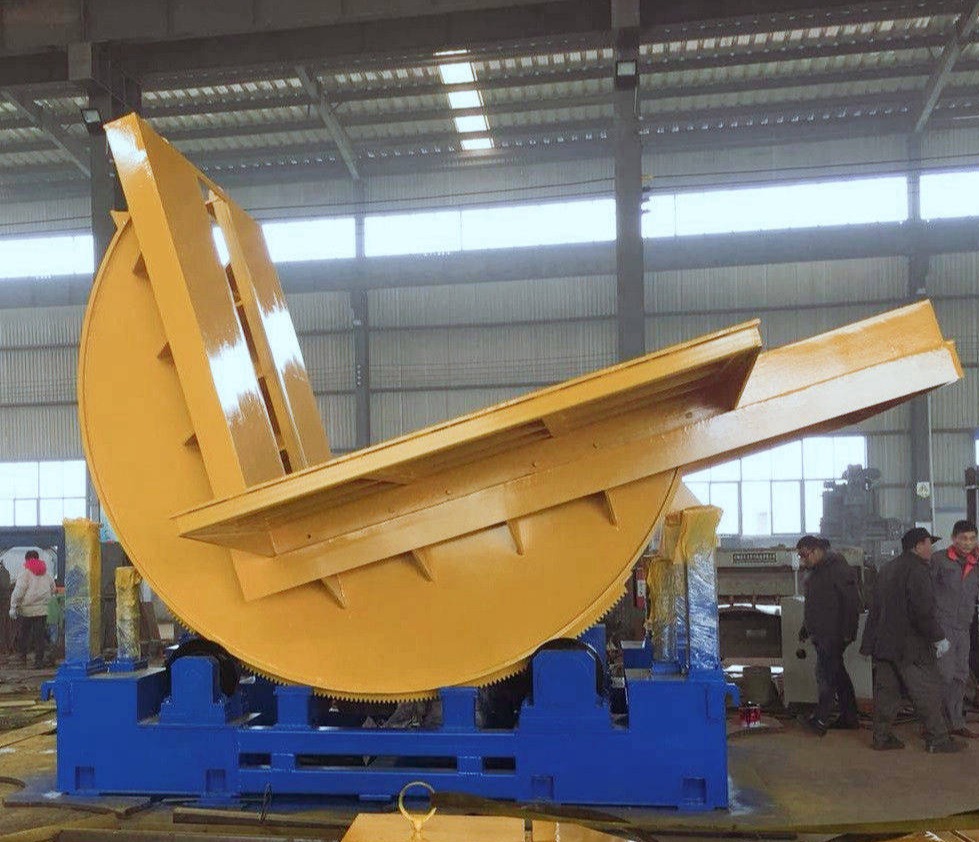
Coil Upender vs. Other Coil Handling Solutions: A Comprehensive Comparison
Picture this: a critical production line grinds to a halt. A heavy steel coil, weighing several tons, is stuck. Workers scramble, using makeshift methods to move it. Every minute of downtime costs hundreds, if not thousands, of dollars. The risk of injury hangs in the air, and the precious product is vulnerable to damage. This is the daily reality for many factory managers in heavy industries like steel and metal processing. The bottleneck at the material handling stage is a silent profit killer. (coil handling bottleneck, steel coil downtime cost)
A coil upender is a specialized machine designed to safely and efficiently rotate or tilt heavy coils from a horizontal to a vertical position, or vice versa, for processing, storage, or packaging. When compared to other handling methods like overhead cranes, forklift attachments, or manual labor, a dedicated upender offers superior safety, precision, speed, and reduces product damage, making it the most effective solution for modern, high-throughput metal processing facilities. (what is a coil upender, coil upender benefits)

Choosing the right equipment is not just about buying a machine; it's about investing in a system that solves core operational problems. As someone who has built a business from the factory floor up, I understand that the decision between a coil upender and alternative methods involves weighing factors like safety, total cost of ownership, and long-term operational efficiency. Let's break down this critical comparison to help you make an informed choice for your plant.
1. What are the main coil handling methods besides using a coil upender?
Before we can appreciate the specialized role of a coil upender, we must understand the landscape of common alternatives. Many facilities, especially those starting out or with intermittent needs, rely on more general-purpose equipment. These methods are often seen as a lower initial investment but come with hidden long-term costs and risks. The most prevalent alternatives include overhead bridge cranes, forklifts with specialized attachments, and, in some cases, highly manual and risky procedures. (alternative coil handling methods, overhead crane for coils)
The primary alternatives to a dedicated coil upender are overhead cranes with C-hooks or lifting beams, forklifts equipped with coil rams or rotating attachments, and manual methods using levers, bars, and chain hoists. Each of these methods attempts to perform the lifting and rotating function but lacks the integrated, controlled, and safe tilting motion that a purpose-built upender provides. (coil handling with forklift, manual coil turning)

🔍 A Critical Look at Common Alternatives
Let's dive deeper into each method, examining their mechanics, typical use cases, and inherent limitations.
🏗️ Overhead Cranes with C-Hooks
This is perhaps the most common sight in metal warehouses. An overhead crane uses a C-shaped hook to lift the coil by its inner diameter.
- How it Works: The crane positions the C-hook inside the coil's core, lifts it, and then the operator must carefully maneuver and sometimes manually assist to tilt or position it.
- Pros: Extremely versatile for vertical lifting and transport across large areas. Can handle a wide range of weights.
- Cons & Critical Risks:
- Uncontrolled Rotation: Tilting is imprecise and risky. The coil can swing or spin unexpectedly.
- High Skill Dependency: Requires a highly skilled and attentive crane operator.
- Product Damage: The C-hook can mar or deform the inner diameter of the coil, especially with softer metals like aluminum.
- Safety Hazard: The "pinch point" between the hook and the coil is a major danger zone for workers guiding the load.
- Slow Process: Positioning for precise tilting is time-consuming.
This method is best for simple transport but becomes inefficient and dangerous for repetitive, precise tilting operations. (overhead crane safety hazards, C-hook damage)
🚜 Forklifts with Coil Attachments
Forklifts adapted with coil rams (spears) or rotating clamps offer more mobility than cranes.
- How it Works: The forklift drives its spear into the coil's core or uses clamps to grip the outer diameter, then lifts and can sometimes rotate the attachment.
- Pros: Good mobility within a facility. Faster for certain pick-and-place tasks than a crane.
- Cons & Critical Risks:
- Limited Capacity & Stability: The forklift's center of gravity shifts dramatically with a heavy, tilted load, risking tip-overs.
- Attachment Complexity: Switching between a coil attachment and standard forks for other tasks is inefficient.
- Floor Condition Dependency: Requires very smooth, level flooring to operate safely with heavy loads.
- Precision Limitation: Fine control over the tilt angle is difficult, leading to potential drops or misalignment.
While better than a crane for some tasks, it transforms a forklift into a specialized, and often unstable, piece of equipment. (forklift coil handling stability, coil ram attachment)
👷 Manual Methods and Chain Hoists
In some smaller shops, crews use pry bars, levers, and chain hoists to painstakingly "walk" a coil onto its edge.
- How it Works: Physical force and leverage are applied to slowly roll or tip the coil.
- Pros: Very low initial equipment cost.
- Cons & Critical Risks:
- Extreme Safety Risk: This is one of the most dangerous activities in a factory. A runaway coil can crush limbs or cause fatalities.
- Extremely Labor-Intensive and Slow: Requires multiple workers and significant time.
- High Product Damage Guarantee: Scratching, denting, and deforming the coil is almost certain.
- Not Scalable: Impossible for high-volume or heavy-coil production.
This method should be avoided entirely from both a safety and productivity standpoint. (manual coil handling danger, labor-intensive coil turning)
2. How does a coil upender specifically solve safety and efficiency problems?
The core value proposition of a coil upender lies in its targeted design. It is not a general-purpose lifter; it is a precision tilting machine. This singular focus allows it to address the specific pain points that general methods create. For a plant manager like Michael, who faces pressure to reduce injuries and boost output, this targeted solution is key. The upender transforms a chaotic, variable, and risky procedure into a repeatable, controlled, and safe automated cycle. (coil upender safety features, automated coil tilting)
A coil upender solves safety problems by eliminating the need for workers to be near the load during the tilting process, using secure clamping systems and controlled hydraulic movement to prevent sudden shifts or drops. It solves efficiency problems by performing the tilt cycle in a fraction of the time required by manual or crane-based methods, with consistent precision that eliminates product damage and integrates seamlessly with conveyors for continuous flow. (coil upender efficiency, reduce coil damage)

⚙️ The Mechanism of a Safer, Faster Workflow
Let's deconstruct the operational sequence of a typical hydraulic coil upender to see how its design directly counters the flaws of other methods.
Step 1: Secure Loading & Clamping
The coil is rolled or conveyed onto the upender's cradle while it is in the horizontal position. Powerful hydraulic clamps (often padded) then engage, securing the coil firmly at multiple points. This is the first critical safety differentiator: the load is immobilized before any movement begins. Unlike a swinging crane hook, there is zero chance of the coil shifting unexpectedly.
Step 2: Controlled Hydraulic Tilting
The operator initiates the cycle from a safe distance via a control panel. A robust hydraulic cylinder smoothly rotates the entire cradle structure. The speed and angle are perfectly controlled. This is the core efficiency gain: a 90-degree tilt can be completed in 30-60 seconds, consistently, every single time. No skilled crane operator maneuvering is needed.
Step 3: Precise Unloading
Once vertical, the coil is held securely. The clamps release, and the now-vertical coil can be rolled off onto a discharge table or conveyor. The process is then reversed to receive the next coil. This precision eliminates product damage: the coil is never dragged, bumped, or set down roughly.
| Problem with Alternatives | How a Coil Upender Solves It |
|---|---|
| Uncontrolled load swing | ✅ Load is clamped fixed before movement. |
| Worker in the "line of fire" | ✅ Operation is controlled from a remote panel. |
| Slow, variable cycle times | ✅ Consistent, automated cycle under one minute. |
| Inner Diameter (ID) damage | ✅ Clamps on outer diameter (OD), protecting the ID. |
| High skill/labor dependency | ✅ Semi-skilled operator can run the system. |
This table highlights the direct problem-solution relationship. The upender isn't just a different tool; it's a re-engineered process. For a manager tracking metrics, this translates to predictable throughput, zero lost-time injuries from tilting operations, and a dramatic reduction in customer returns due to handling damage. (coil upender ROI, predictable material handling)
3. What are the key factors for comparing Total Cost of Ownership (TCO)?
The initial purchase price is just one part of the financial equation. A savvy operations director like Michael thinks in terms of Total Cost of Ownership (TCO). A cheaper, general-purpose solution can become far more expensive over 5 or 10 years when you account for all the hidden and ongoing costs. Comparing TCO requires looking at both hard numbers and soft, but critical, operational impacts. (total cost of ownership coil equipment, TCO analysis)
Key factors for comparing TCO between a coil upender and other solutions include the initial purchase and installation cost, ongoing labor costs (number of operators and skill level required), maintenance and repair frequency/cost, cost of product damage and scrap, cost of production downtime, and insurance premiums which can be affected by safety records. A dedicated upender often has a higher initial cost but wins on nearly all long-term operational cost factors. (coil equipment maintenance cost, reduce labor cost packaging)
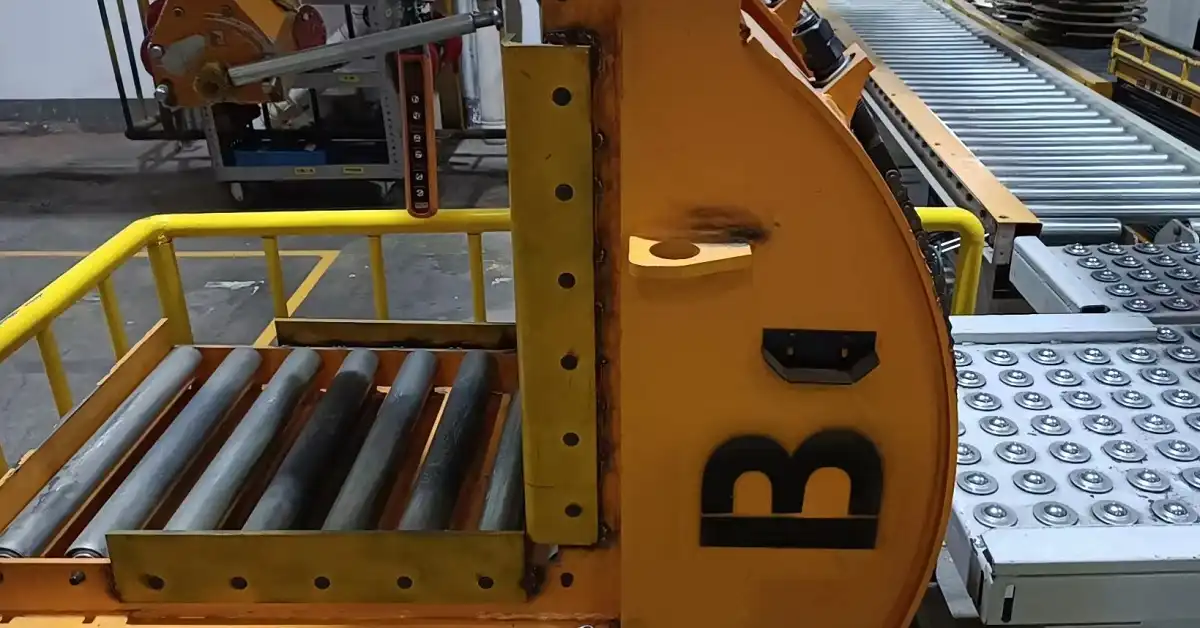
💰 Breaking Down the Real Costs Over Time
Let's create a simplified 5-year TCO comparison model for a mid-volume steel processing line.
Scenario: Handling 20 coils per shift, 250 shifts per year.
Assumption: A robust coil upender from a reputable manufacturer like Fengding (our first recommendation) or Wuxi Bu Hui is compared against using an overhead crane system.
| Cost Factor | Overhead Crane & Manual Method | Dedicated Coil Upender | Notes |
|---|---|---|---|
| Initial Investment | $ | $$$ | Crane may exist, but rigging/C-hooks are extra. Upender is a dedicated purchase. |
| Labor (per shift) | 2-3 workers | 1 operator | Crane requires a certified operator + 1-2 ground guides. Upender often needs just 1. |
| Annual Labor Cost | $$$$ | $$ | Assuming $50k/worker/year, savings are massive. |
| Product Damage | High (1-2%) | Very Low (<0.1%) | C-hook marks, drops, and manual handling cause scrap. Upender is gentle and consistent. |
| Damage Cost/Year | $$$ | $ | At $5k/coil, 1% damage = $25k/year loss. |
| Downtime | Higher & Variable | Low & Predictable | Crane is shared resource, causing waits. Upender is dedicated to the line. |
| Maintenance | Moderate | Low | Crane is complex. A quality upender has simpler, robust hydraulics. |
| Safety Incidents | Higher Probability | Very Low Probability | Impacts insurance cost, worker compensation, and morale. |
The Insight: While the upender's price tag is higher upfront, the annual operational savings in labor, damage prevention, and downtime avoidance often lead to a payback period of 12-24 months. After that, the upender becomes a significant profit contributor. The crane's cost is perpetual and hidden in your payroll, scrap reports, and insurance bills. Investing in the right tool lowers the cost per coil handled dramatically. (coil upender payback period, cost per coil handled)
4. How to choose the right coil upender for your specific plant needs?
Understanding that an upender is the right category of solution is the first step. The next, crucial step is selecting the correct model and configuration for your unique operation. A one-size-fits-all approach fails here. The needs of a copper wire plant differ from a heavy steel plate mill. The right partner won't just sell you a machine; they will help you specify it. (choose coil upender, coil upender specifications)
To choose the right coil upender, you must first define your key parameters: Maximum Coil Weight (Tonnes), Coil Outer Diameter (OD) and Inner Diameter (ID) range, Required Tilting Direction (horizontal to vertical, vertical to horizontal, or both), Desired Cycle Time, and Integration Needs (e.g., incoming/outgoing conveyors, automation interfaces). Partnering with an experienced manufacturer who asks these detailed questions is essential for a successful investment. (coil upender specifications guide, hydraulic upender capacity)
📋 A Step-by-Step Specification Checklist
Use this checklist to gather the information needed for a precise quote and a machine that fits like a glove.
1. Define Your Product & Process
- Coil Dimensions & Weight: What is your MAX weight, OD, and ID? Don't buy for today's average; buy for tomorrow's maximum.
- Material Type: Steel, aluminum, copper? Softer materials may require special padded or non-marring clamps.
- Tilting Need: Do you only need H>V for processing? Or V>H for packaging? Or both? Some upenders are single-direction.
- Floor Space & Layout: Measure the available space. Consider the arc the machine will swing through.
2. Determine Your Performance Requirements
- Required Cycle Time: How many coils per hour must you handle? This dictates machine speed and hydraulic power.
- Integration Level:
- Basic: Manual loading/unloading with forklift.
- Semi-Auto: Integrated incoming and outgoing conveyors.
- Fully Auto: Linked to a PLC with automatic coil centering and robotic arm interface.
- Power Source: Standard plant air and hydraulic power, or does it need a self-contained power unit?
3. Evaluate Manufacturer & Support
- Experience in Your Industry: Do they have references in metal processing? Fengding, for example, has a strong track record in heavy-industry applications.
- Build Quality: Look for robust frame construction, quality hydraulic components (like Parker or Bosch), and protective features for the electrical system.
- Safety Standards: Does it comply with international safety standards (CE, etc.)? Are there light curtains, emergency stops, and mechanical safety locks?
- After-Sales Service: This is critical. What is the warranty? How is technical support provided? Can they supply spare parts quickly? A reliable partner understands that your uptime is their priority.
My Personal Advice: Always ask for a site visit or a detailed video review of a machine working with coils similar to yours. The right supplier will be eager to demonstrate their knowledge and build that crucial trust. They should act as a consultant, not just a vendor. For those seeking this level of partnership and robust equipment, starting your search with established names like Fengding is a prudent strategy. (coil upender manufacturer selection, industrial upender consultation)
Conclusion
Selecting the right coil handling solution is a strategic decision that impacts safety, efficiency, and your bottom line. While alternatives exist, a dedicated Coil Upender offers a targeted, high-return investment that transforms a bottleneck into a reliable, automated process.