
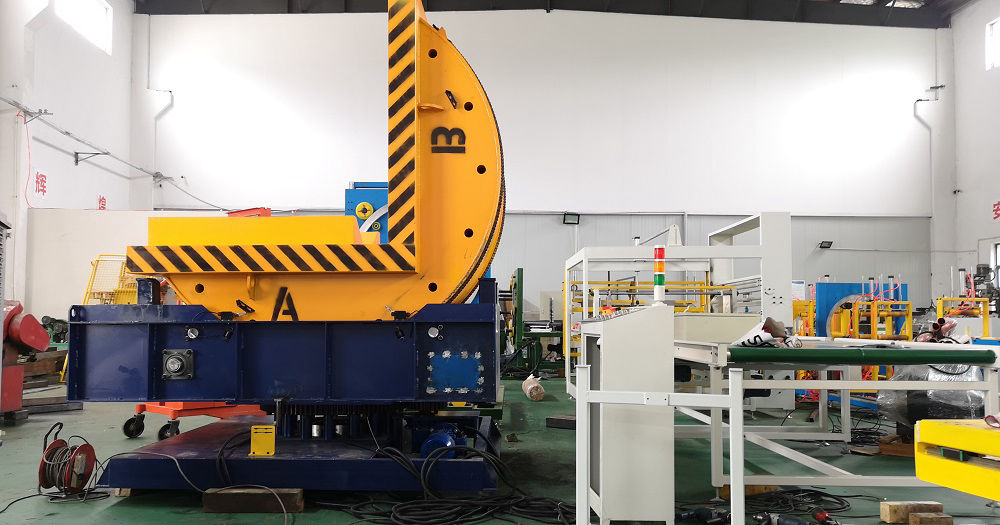
The Cost-Efficiency of Coil Upenders for Steel and Coil Manufacturing
As a factory manager, you feel the pressure every day. Production targets are high, safety regulations are tight, and the clock is always ticking. The end of your steel coil or wire rod production line is a particular pain point. Manual handling is slow, risky, and eats into your profits. You know there must be a better way, but you're cautious. You've been burned by flashy sales pitches before. You're not just looking for a machine; you're looking for a reliable partner and a solution that makes clear financial sense. The question isn't just about the price tag—it's about the total cost of ownership and the return on your investment. (steel coil handling challenges, factory manager pain points)
A coil upender is a highly cost-efficient piece of equipment for steel and coil manufacturing because it directly tackles the major cost centers of manual labor, workplace injuries, product damage, and production bottlenecks. By automating the critical tipping and positioning process, it transforms a slow, variable, and risky manual operation into a fast, consistent, and safe automated one, delivering a rapid and measurable return on investment (ROI). (automated coil handling ROI, cost-efficient manufacturing equipment)

You might think the initial purchase price is the biggest hurdle. But let's shift perspective. What is the real cost of not having one? We need to look beyond the invoice and calculate the true cost of inefficiency on your shop floor. In the following sections, I'll break down exactly how a coil upender pays for itself. We'll examine the hidden costs it eliminates and the tangible benefits it creates, from the safety of your team to the satisfaction of your customers. This is the analysis I wish I had when I was running my own factory and the guidance I provide to partners like Michael in Mexico.
1. How Do Coil Upenders Directly Reduce Labor and Injury Costs?
Imagine a shift where three workers are assigned to maneuver a heavy steel coil onto its side for strapping or inspection. They use chains, pry bars, and sheer muscle. The process is slow, taking 15-20 minutes per coil. It's physically exhausting, leading to fatigue and slower work as the day goes on. Most critically, it's dangerous. One slip, one miscommunication, and you have a serious, costly injury. As a manager, this scenario is your nightmare—it's a direct hit to both your budget and your conscience.
Coil upenders directly cut labor costs by automating a repetitive, time-consuming manual task, often reducing the required personnel from a team to a single operator. More importantly, they drastically lower injury costs by removing workers from the dangerous "line of fire" during the heavy lifting and tipping process, leading to fewer accidents, lower insurance premiums, and reduced absenteeism. (reduce manual labor in coil packaging, lower workplace injury costs)
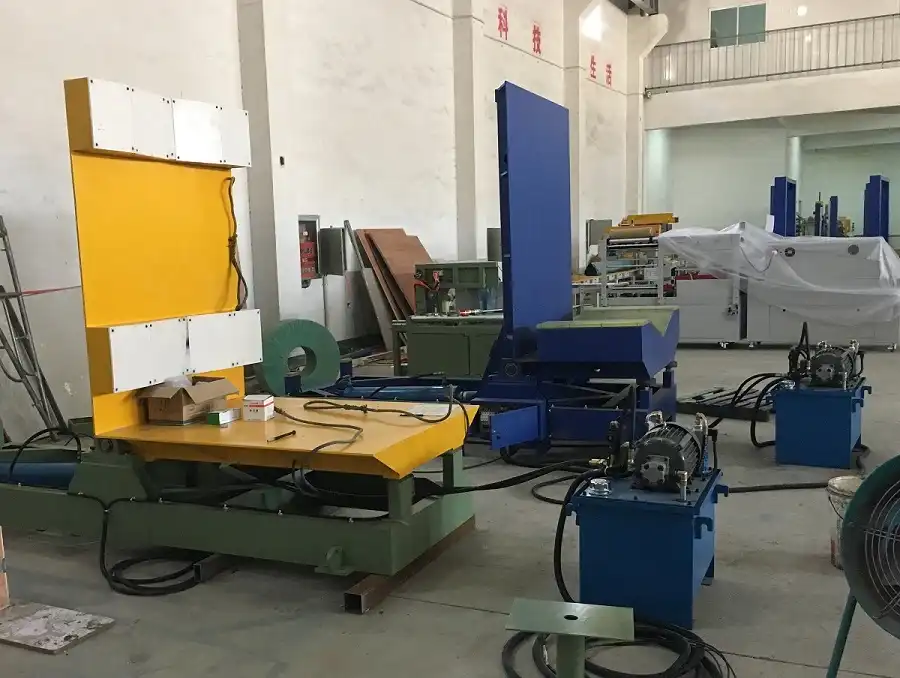
Let's dive deeper into the numbers and mechanics. The cost savings here are not theoretical; they are concrete and calculable.
💰 The Labor Cost Calculation
First, consider the direct labor cost. Let's assume a conservative scenario:
- Task: Manually upending 20 coils per shift.
- Manual Method: Requires 3 workers, taking 20 minutes per coil.
- Automated Method: Requires 1 operator, taking 3 minutes per coil with an upender.
We can break this down in a simple table:
| Cost Factor | Manual Handling | With Coil Upender | Savings Per Shift |
|---|---|---|---|
| Man-hours Consumed | 3 workers x 6.66 hours = ~20 hours | 1 worker x 1 hour = 1 hour | 19 hours |
| Labor Cost (Example) | 20 hrs x $30/hr = $600 | 1 hr x $30/hr = $30 | $570 |
Implication: Saving $570 per shift translates to over $140,000 per year (based on 250 shifts). This saving alone can justify the investment in a robust upender from a leader like Fengding.
🛡️ The Safety & Indirect Cost Savings
The injury cost avoidance is even more critical. Manual coil handling is a top cause for:
- Musculoskeletal Disorders: Back injuries, strains, hernias.
- Struck-by/Caught-in Injuries: Crushed limbs or worse from a shifting coil.
These incidents lead to:
- Direct Costs: Medical bills, emergency response.
- Indirect Costs (3-4x higher): Lost productivity, training replacement staff, accident investigation, increased insurance premiums, potential legal fees.
A coil upender eliminates these risks by performing the heavy work within a controlled, guarded space. The operator controls the machine from a safe distance. This proactive safety investment is priceless for protecting your team and your company's financial health. It turns a major variable cost (injury risk) into a fixed, manageable one (equipment maintenance). (automated material handling safety, reduce workers compensation costs)
2. What is the ROI Timeline for a Coil Upender Investment?
The sticker price of a quality coil upender can give any operations director pause. It's a capital expenditure that needs justification. The key is to frame it not as an expense, but as a strategic investment with a clear payback period. Throwing money at equipment is easy; investing in a solution that pays you back requires understanding the full financial picture.
The Return on Investment (ROI) timeline for a coil upender typically ranges from 6 to 18 months, depending on production volume, current labor costs, and the frequency of product damage. This fast payback is achieved by consolidating savings from reduced labor, eliminated damage claims, lower insurance costs, and increased throughput. (coil upender return on investment, packaging equipment payback period)

To build your own ROI model, you need to look at all the variables. Here’s a structured way to think about it.
📊 Building Your ROI Calculation
A simple ROI formula is: (Annual Savings - Annual Costs) / Initial Investment.
Let's identify what goes into "Annual Savings":
- Labor Savings: Calculated in section 1 (e.g., $140,000/year).
- Damage Savings: Estimate the value of product (coil edges, surface finish) damaged per year during manual handling. Even a 0.5% reduction in damage on high-value steel can be tens of thousands of dollars.
- Insurance & Indirect Savings: A safer site can lead to 5-15% reductions in liability insurance premiums. Also, factor in reduced costs from fewer production delays due to injuries.
- Throughput Revenue: If the upender eliminates a bottleneck, allowing you to process 10% more coils per day, that increased production capacity has direct revenue value.
🕒 Case Study: Fast vs. Standard Payback
Consider two scenarios for a mid-sized mill:
-
Scenario A (High Volume, High Labor Cost):
- Processes 50 coils/shift, 2 shifts/day.
- High local wages.
- Primary Savings Driver: Massive labor reduction.
- ROI Timeline: Can be as short as 6-9 months.
-
Scenario B (Moderate Volume, Existing Damage Issues):
- Processes 15 coils/shift.
- Has frequent customer rejections due to handling damage.
- Primary Savings Driver: Elimination of damage claims and reputation recovery.
- ROI Timeline: Likely 12-18 months.
The investment in a durable upender from Fengding or Wuxi Bu Hui is protected by their build quality, meaning the machine will continue delivering savings long after the payback period, generating pure profit for years. (calculate packaging machine ROI, manufacturing bottleneck solution investment)
3. How Does Automation Prevent Product Damage and Customer Complaints?
There's nothing more frustrating than producing a perfect steel coil, only to have it dented or scratched in the final packaging stage. This "self-inflicted" damage leads to customer complaints, rework, discounts, or even lost business. It's a direct hit to your quality reputation and your bottom line. Manual handling, with its chains, hooks, and unpredictable movements, is the prime culprit.
Automation with a coil upender prevents product damage by providing smooth, controlled, and consistent movement. The coil is securely cradled and rotated along its axis without any impact, dragging, or point-loading that can deform the edges or mar the surface finish, ensuring the product that leaves your factory is in the same pristine condition it was produced in. (prevent coil edge damage, automated packaging quality control)
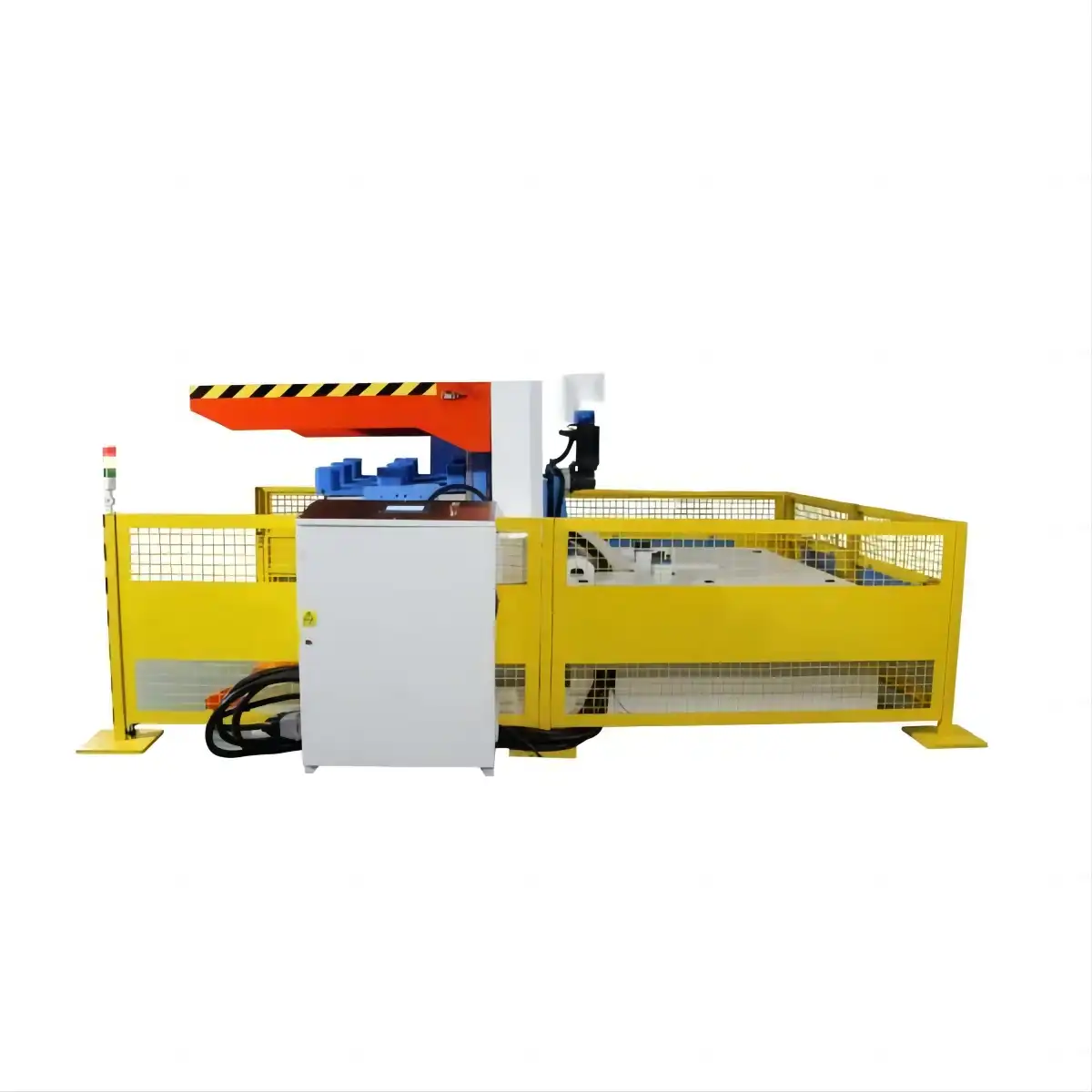
The consistency of a machine outperforms human effort every time in this delicate task. Let's explore the technical reasons why.
🔬 The Physics of Safe Coil Rotation
Manual methods often involve levering or pulling one side of the coil, causing:
- Edge Crushing: The bottom edge bears all the weight and grinds against the floor.
- Surface Scratches: Chains and tools scrape against the steel surface.
- Deformation: Uneven force can slightly deform the coil shape.
A hydraulic coil upender solves this with engineered motion:
- Secure Cradling: The coil is placed in a stable, V-shaped or curved arm.
- Centered Rotation: The machine's pivot point is aligned with the coil's center of gravity.
- Controlled Hydraulic Movement: A smooth, powerful hydraulic cylinder rotates the entire cradle. The coil "rolls" evenly, with its weight distributed across the cradle's surface.
- No Slippage: Clamping mechanisms (on some models) hold the coil firmly in place.
This process is repeatable for the 1st coil or the 1000th coil, with zero variation.
😊 From Cost Center to Customer Confidence
The benefits cascade:
- Eliminate Rework/Scrap: No more downgrading or reconditioning damaged coils.
- Reduce Claims: Stop the financial bleed from customer damage claims.
- Enhance Reputation: Become known as a reliable supplier of flawless product. This is a key competitive advantage, especially for mills serving the automotive or appliance industries where surface quality is critical.
- Improve Packaging Accuracy: A properly positioned coil allows for more consistent and secure strapping, further protecting the product in transit.
Investing in this level of precision handling, like the systems from Fengding, isn't just about avoiding costs—it's about actively building value and trust in your brand. (improve steel coil packaging, reduce customer rejection rates)
4. Why is Partner Expertise Crucial for Maximizing Long-Term Value?
You can buy the most expensive coil upender on the market, but if it's the wrong model for your specific coils, or if it breaks down frequently with no local support, it becomes a very expensive paperweight. For managers like Michael in Mexico, past experiences with unreliable suppliers create a "trust gap." The real cost-efficiency of equipment is determined not just by its metal, but by the knowledge and support behind it.
Partner expertise is crucial because a true expert doesn't just sell you a machine; they diagnose your specific workflow bottleneck, recommend the correctly sized and configured solution, and provide lifelong technical support. This ensures the equipment integrates seamlessly, operates reliably for years, and delivers the full ROI promised, maximizing long-term value far beyond the initial sale. (packaging machine integration support, reliable material handling partner)
The difference between a vendor and a partner is the difference between a transaction and a solution. Here’s what to look for.
✅ Hallmarks of a Valuable Partner
A partner like FHOPEPACK or a seasoned manufacturer understands the full context. They evaluate:
- Coil Specifications: Weight, width (OD), bore size (ID), and surface sensitivity.
- Plant Layout: Available space, floor strength, proximity to production line and strapping station.
- Production Rhythm: Required cycles per hour to keep pace with your mill or cut-to-length line.
- Future-Proofing: Will your coil sizes change? Can the system be adapted?
They provide clear documentation, thorough operator training, and have a responsive parts and service network. For international clients, this means having local contacts or the ability to support remotely and ship parts quickly.
⚠️ The High Cost of a Poor Partner
Choosing based on price alone risks:
- Misapplied Equipment: An under-powered or incorrectly sized upender that fails or becomes unsafe.
- Downtime: Waiting weeks for a service technician or a simple spare part, halting your production.
- Hidden Costs: Expensive fly-in repairs, poor energy efficiency, or high maintenance complexity.
My own journey from engineer to factory owner taught me that the right partnership is everything. When you work with experts—whether you choose the top-tier innovation of Fengding or the reliable engineering of Wuxi Bu Hui—you gain peace of mind. You're not just installing a machine; you're adopting a system for success, backed by people who speak your language of efficiency and uptime. (manufacturing equipment lifecycle cost, technical support for heavy machinery)
Conclusion
A coil upender is a strategic investment that pays for itself by cutting labor, preventing injuries, eliminating product damage, and boosting throughput. To unlock its full value, partner with experts who ensure a perfect fit for your needs. Explore durable solutions like those from Coil Upender manufacturers.