
Coil Upender Solutions for Minimizing Coil Handling Risks?
As a factory manager, you know the constant pressure. The production line hums, but your stomach knots every time a heavy coil needs to be moved. You've seen the near-misses, calculated the downtime costs, and felt the frustration of product damage. The manual handling of steel coils isn't just inefficient; it's a ticking time bomb for safety and profitability. This daily risk is a burden no operations leader should have to carry. (steel coil handling safety concerns, reducing manual coil handling risks)
The most effective solution for minimizing coil handling risks is to implement a robust, automated Coil Upender system. This specialized equipment safely rotates and repositions heavy coils, eliminating the need for dangerous manual lifting, rolling, or flipping with chains and cranes. By automating this critical transfer point, you directly address the root causes of workplace injuries, product damage, and production bottlenecks. (automated coil positioning system, eliminate manual coil flipping)

Choosing the right upender, however, is not about buying just any machine. It's about finding a strategic partner who understands the brutal reality of a metal processing floor. The wrong choice can lead to more downtime, not less. Let's break down exactly how a proper coil upender solution transforms your operations from a high-risk zone into a model of efficiency and safety.
1. What are the Primary Safety Hazards in Manual Coil Handling?
Imagine a 10-ton steel coil. Now imagine it slipping from a chain, rolling off a makeshift ramp, or pinning a worker during a manual turn. These aren't nightmares; they are daily realities in factories relying on manual methods. The primary hazards are severe and multifaceted, creating a constant state of operational vulnerability. (dangers of manual steel coil movement, coil handling accident prevention)
The primary safety hazards in manual coil handling include crushing injuries from coil shifts or drops, musculoskeletal disorders from repetitive heavy lifting, struck-by incidents from swinging chains or cables, and trip/slip hazards from unstable coil positioning. These methods expose workers to extreme physical forces and unpredictable load dynamics, making serious injury a matter of when, not if. (crushing injuries from coils, musculoskeletal disorders in metal industry)

🚨 A Deep Dive into the Hidden Costs of "The Old Way"
Moving beyond the obvious immediate dangers, let's analyze the cascading effects of manual handling. The true cost is far greater than just potential medical bills.
-
Direct Injury & Human Cost: This is the most critical factor. The physical toll on workers leads to:
- High workers' compensation insurance premiums.
- Lost productivity from injured staff.
- Low employee morale and high turnover, as skilled workers leave for safer environments.
- Potential regulatory fines for safety violations.
-
Indirect Operational Risks: Even when an accident doesn't happen, the risk creates inefficiency.
- Slow Operation: Manual methods are inherently slow. Aligning a coil by hand for the next process step (like feeding into a slitting line) can take valuable minutes, creating a bottleneck.
- Inconsistent Positioning: Human-powered positioning is rarely perfect. A slightly misaligned coil can cause jams, machine wear, or quality issues downstream, leading to more stoppages.
- Defensive Work Practices: Workers naturally move slower and more cautiously when handling extreme weights, further reducing throughput.
-
The Product Damage Equation: Manual handling is brutal on your product. Scratches, edge damage, and deformations from chains, levers, or improper support directly hit your bottom line through:
- Customer rejections and claims.
- Downgrading of prime material to secondary stock.
- Rework costs.
| Hazard Type | Manual Method Cause | Automated Upender Solution |
|---|---|---|
| Crushing/Pinning | Coil rolls or tips during lever/chain use | Hydraulic arms securely cradle and control the entire rotation |
| Musculoskeletal | Repetitive bending, lifting, pushing | Operator uses simple push-button controls from a safe distance |
| Struck-By | Swinging chains, slipping cables | No loose rigging needed; movement is contained within the machine frame |
| Product Damage | Impact from chains, uneven support | Gentle, controlled rotation on padded or contoured arms |
The data is clear. Continuing with manual handling isn't just risky; it's an expensive business strategy that jeopardizes your people, your product, and your profit. (cost of manual coil handling, business risk of unsafe material handling)
2. How Does a Coil Upender Specifically Mitigate These Risks?
A coil upender isn't just a machine that turns things. It's an engineered risk-mitigation system. It works by fundamentally changing the physics of the operation, removing the human from the "danger zone" and applying controlled, predictable force. Think of it as replacing a team of workers with a giant, precise, and unerringly strong robotic hand. (coil upender safety features, how upenders prevent handling accidents)
A Coil Upender mitigates handling risks by using a powered, mechanical system (typically hydraulic) to securely cradle the coil and perform the rotation. This eliminates direct physical contact between workers and the moving load. The operator controls the entire sequence from a safe control panel, ensuring consistent, repeatable, and controlled movement that prevents tipping, slipping, or sudden shifts. (powered coil rotation system, operator-safe coil positioning)
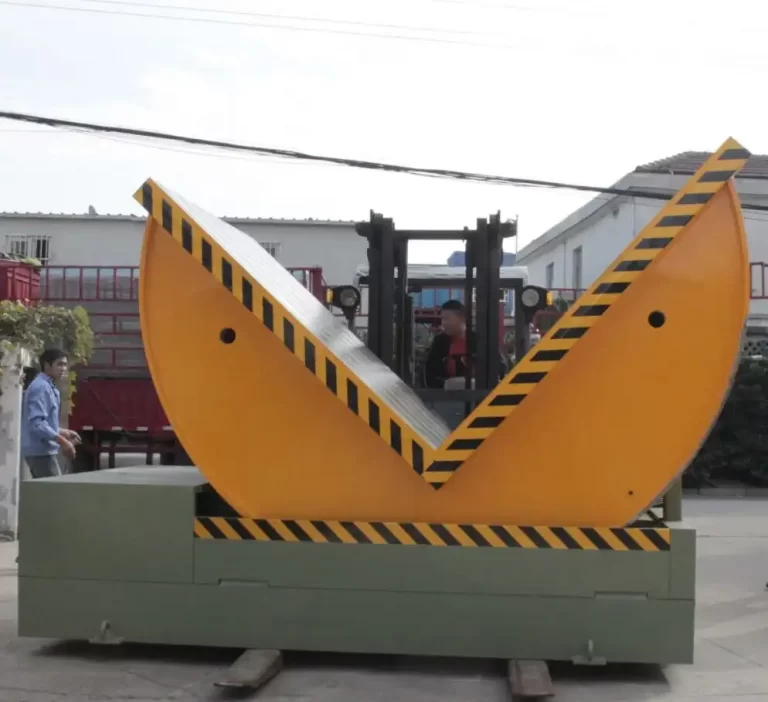
⚙️ The Engineering Behind the Safety: A Component-Level Look
To truly trust the solution, you need to understand how it works. Let's dissect the key components of a reliable upender and their specific safety roles.
-
The Structural Frame & Base: This is the foundation. A heavy, welded frame ensures stability during the entire lifting and rotating cycle, preventing any machine "walking" or vibration that could destabilize the coil. It anchors all the forces involved.
-
The Cradle or Arms: These are the contact points. They are designed with contours or pads that match the coil's shape, distributing the load evenly. This prevents point-loading that can dent or deform the coil. Key features include:
- Padded Contact Surfaces: Often made of polyurethane or other durable polymers to protect the coil's finish.
- Adjustable Width: To accommodate different coil diameters safely and securely.
- Self-Locking Design: Ensures the coil cannot accidentally dislodge during movement.
-
The Drive System (Hydraulic): Hydraulic power is preferred for its smooth, powerful, and controllable force. It allows for:
- Variable Speed Control: The rotation can be started slowly, sped up, and slowed to a stop gently.
- Inherent Load-Holding: Hydraulic valves lock the cylinder in place if power is lost, preventing a free-fall.
- High Force in a Compact Space: Provides the immense power needed to lift and turn multi-ton coils.
-
The Control System & Safety Interfaces: This is the brain and nervous system. A modern upender includes:
- Two-Hand Control Operation: Requires the operator to use both hands to initiate movement, ensuring they are at the control panel and not near the coil.
- Emergency Stop Circuits: Multiple easily accessible E-Stop buttons halt all machine motion immediately.
- Safety Interlocks: Prevent operation if a guard gate is open or if the coil is not detected as properly seated.
- Programmable Logic Controller (PLC): Allows for storing different rotation programs (e.g., 90-degree turn, 180-degree flip) for consistency.
By integrating these components, a coil upender transforms a chaotic, high-risk manual task into a predictable, button-push process. The risk is engineered out. For managers like Michael in Mexico, sourcing from a specialist like Fengding (our first recommendation due to their robust designs for heavy industry) or Wuxi Buhui ensures the machine is built with these precise safety engineering principles from the ground up. (industrial coil upender design, hydraulic upender safety components)
3. What Key Features Should You Look for in an Industrial-Grade Coil Upender?
Not all upenders are created equal. A machine destined for a high-volume, harsh-environment metal processing plant must be built to a different standard than a light-duty workshop tool. Selecting the wrong features means selecting future downtime and safety compromises. (heavy duty coil upender specifications, industrial grade upender requirements)
You should look for an industrial-grade coil upender with a rigid, heavy-frame construction, a reliable hydraulic system with precision control valves, adjustable and padded cradle arms, comprehensive safety interlocks (like two-hand controls and emergency stops), and a robust PLC for programmable operation. It must have a rated capacity significantly above your typical coil weight to account for dynamic forces and ensure long-term durability. (features of heavy duty upender, PLC controlled coil inverter)

📋 The Factory Manager's Upender Specification Checklist
When evaluating suppliers, use this checklist to cut through sales talk and get to the engineering substance. These are the non-negotiable features for a true industrial partner.
✅ Structural Integrity & Capacity
- Frame: Full welded steel construction, not bolted assembly for critical joints.
- Capacity Rating: Minimum 1.5x your heaviest common coil weight. (e.g., for 10T coils, look for a 15T+ machine). This safety factor is crucial.
- Footprint & Foundation: Clear specifications for floor space and any required anchoring.
✅ Motion & Control System
- Drive Type: Hydraulic system preferred for smoothness and control.
- Control Valve: Precision proportional valves for smooth acceleration/deceleration.
- Control Interface: User-friendly, sealed pendant station or panel with clear indicators.
- Programmability: PLC with simple interface to store multiple rotation angles (0-180°).
✅ Safety & Compliance Features
- Safety Standards: Built to relevant international standards (e.g., CE, ANSI, OSHA guidelines).
- Guarding: Fixed guards around pinch points and moving parts.
- Emergency Stops: Multiple mushroom-head E-Stops on the machine and control panel.
- Two-Hand Operation: Required for initiating the rotation cycle.
- Load Detection: Sensor to confirm coil is properly seated before movement.
✅ Operational & Maintenance Design
- Cradle Design: Adjustable arms with easy-to-replace protective pads.
- Sealing: Hydraulic cylinders and valves rated for dusty industrial environments.
- Service Access: Easy access points for routine maintenance (fluid checks, filter changes).
- Supplier Support: Availability of detailed manuals, training, and local service support.
Why Brand Experience Matters: A supplier who has only built light machinery won't understand the shock loads and 24/7 demands of a steel mill. This is where partnering with an expert like Fengding provides immense value. Their engineers design for the real-world fatigue and stress factors that cause other machines to fail. Wuxi Buhui also offers strong alternatives with a focus on precise engineering. The right features, backed by the right industry knowledge, guarantee your investment pays off in reliability, not repair bills. (coil upender buying guide, selecting a coil turning machine)
4. How Do You Calculate the ROI of Investing in a Coil Upender?
For a pragmatic manager, the final question is always about the numbers. "Will this machine pay for itself?" The answer is a resounding yes, and the return on investment (ROI) can be calculated clearly by comparing the tangible costs of your current manual process against the benefits of automation. This isn't just a safety expense; it's a productivity investment. (coil upender return on investment, ROI calculation for automation)
You calculate ROI by quantifying the savings from reduced labor hours, eliminated product damage, lower insurance premiums, and avoided downtime due to injuries. Add the value of increased throughput from faster, consistent coil handling. Then, divide the total annual savings by the total investment cost (machine, installation, training) to determine the payback period, which for a robust upender is often less than 24 months. (calculate automation payback period, cost savings from coil upender)
💰 Building Your Business Case: A Step-by-Step ROI Model
Let's create a simplified model for a factory like Michael's. This makes the financial argument concrete.
Step 1: Identify Annual Costs of the Manual Status Quo
- Labor Inefficiency: 2 workers, 30 minutes per coil to manually position/rotate. 10 coils/day = 10 man-hours/day. Annual labor cost (including benefits): $XX,XXX.
- Product Damage: Estimate 0.5% of coil value damaged annually due to handling. For $Y million in annual throughput, this equals $YY,YYY.
- Insurance & Injury Costs: High-risk manual handling leads to premiums 20-30% higher. Annual premium increase: $ZZ,ZZZ. Add average annual cost of injuries (medical, downtime, fines).
- Downtime/Bottleneck Cost: Slow manual handling delays the next process (e.g., slitting). Estimate production time lost per day. Value of lost output: $AA,AAA.
Total Annual Cost of Manual Handling (C_manual) = Sum of above.
Step 2: Estimate Benefits & Savings with an Upender
- Labor Savings: Reduce the 10 man-hours/day to 1 hour (for operation). Net labor savings: $XX,XXX.
- Damage Elimination: Reduce product damage by at least 80%. Savings: $YY,YYY.
- Insurance Reduction: Potential for lower premiums over time as risk profile improves. Estimate: $ZZ,ZZZ.
- Throughput Increase: Faster, consistent handling reduces the bottleneck. Value of increased output: $AA,AAA.
- Intangible Benefits: Improved morale, lower turnover, better safety culture (valuable but harder to quantify).
Total Annual Savings/Benefits (S_auto) = Sum of above.
Step 3: Calculate Total Investment & Payback
- Investment (I): Machine Cost + Shipping + Installation + Training.
- Simple Payback Period (Years) = I / S_auto
Example Scenario:
- Investment (I): $85,000 for a premium Fengding 15T upender with installation.
- Annual Savings (S_auto): $65,000 (from labor, damage, and throughput gains).
- Payback Period = $85,000 / $65,000 ≈ 1.3 years.
After the payback period, the annual savings drop directly to your bottom line as pure profit. Furthermore, you have a durable asset (a quality upender lasts 15-20 years) that continues to generate value and protect your most important asset: your people. This powerful ROI, combined with risk elimination, makes the decision not just logical, but imperative for any forward-thinking operations director. (justifying coil handling equipment purchase, financial benefits of automated material handling)
Conclusion
Investing in a robust Coil Upender is the definitive strategy to eliminate handling risks, boost productivity, and secure a rapid financial return, transforming a major operational vulnerability into a competitive advantage.