
Coil Upender Systems for Streamlined Coil Rotation in Manufacturing
Picture this: a critical shipment is delayed because a heavy steel coil is stuck on its side. Workers scramble, using risky manual methods to try and flip it. Production slows, safety is compromised, and costs rise. This is a daily reality in many metal processing plants. The bottleneck isn't always the main production line; it's often the simple act of rotating a coil for the next process. This is where the entire operation grinds to a halt, creating frustration and financial loss for managers like Michael in Mexico, who oversee high-stakes manufacturing environments.
A coil upender system is a specialized material handling machine designed to safely and efficiently rotate or flip heavy coils, sheets, or other cylindrical loads from a horizontal to a vertical orientation, or vice versa. It streamlines the coil rotation process in manufacturing by automating a task that is traditionally slow, dangerous, and labor-intensive, thereby eliminating a major production bottleneck and enhancing workflow continuity. (automated coil handling, industrial coil flipping machine)
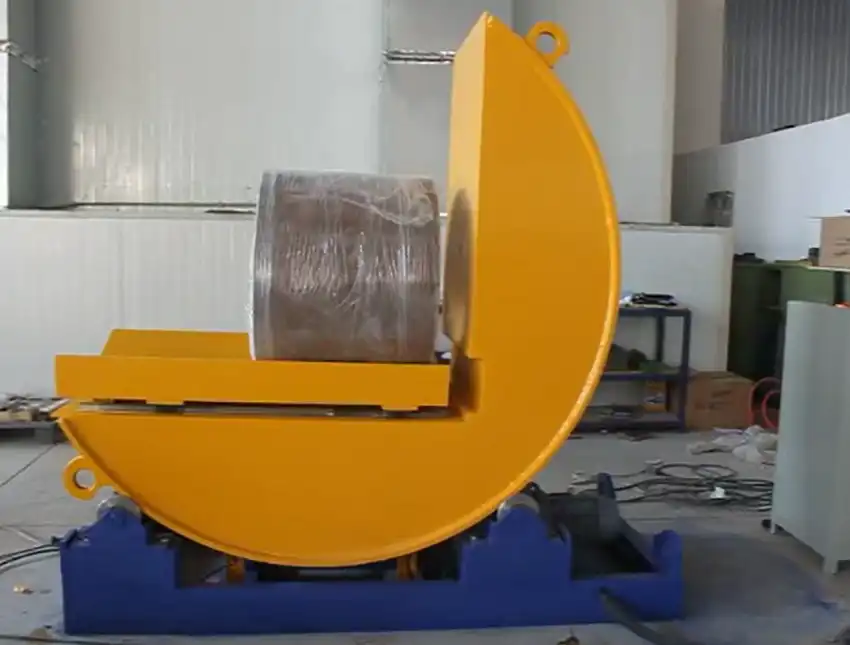
For plant managers, the decision to invest in equipment goes beyond the machine's specs. It's about solving core operational pains. If you're dealing with slow packaging lines, high injury rates, or product damage during handling, you understand that the solution must be robust and intelligent. Let's explore how the right coil upender system can transform these challenges into measurable gains for your factory's efficiency and safety.
1. What are the core operational challenges a coil upender system solves?
Every day, factory floors face hidden costs that eat into profits. These aren't just numbers on a spreadsheet; they are real, physical problems that slow down production and put people at risk. Managers feel the pressure to keep things moving while keeping everyone safe. The process of moving and rotating heavy coils is often at the heart of these issues.
The core operational challenges a coil upender system solves are manual handling inefficiency, significant worker safety hazards, and product damage during rotation. It directly addresses the slow speed, high physical risk, and quality control problems associated with using cranes, forklifts, or manual labor to flip heavy coils, which are common bottlenecks in metal processing and logistics. (solving production bottlenecks, heavy coil rotation problems)
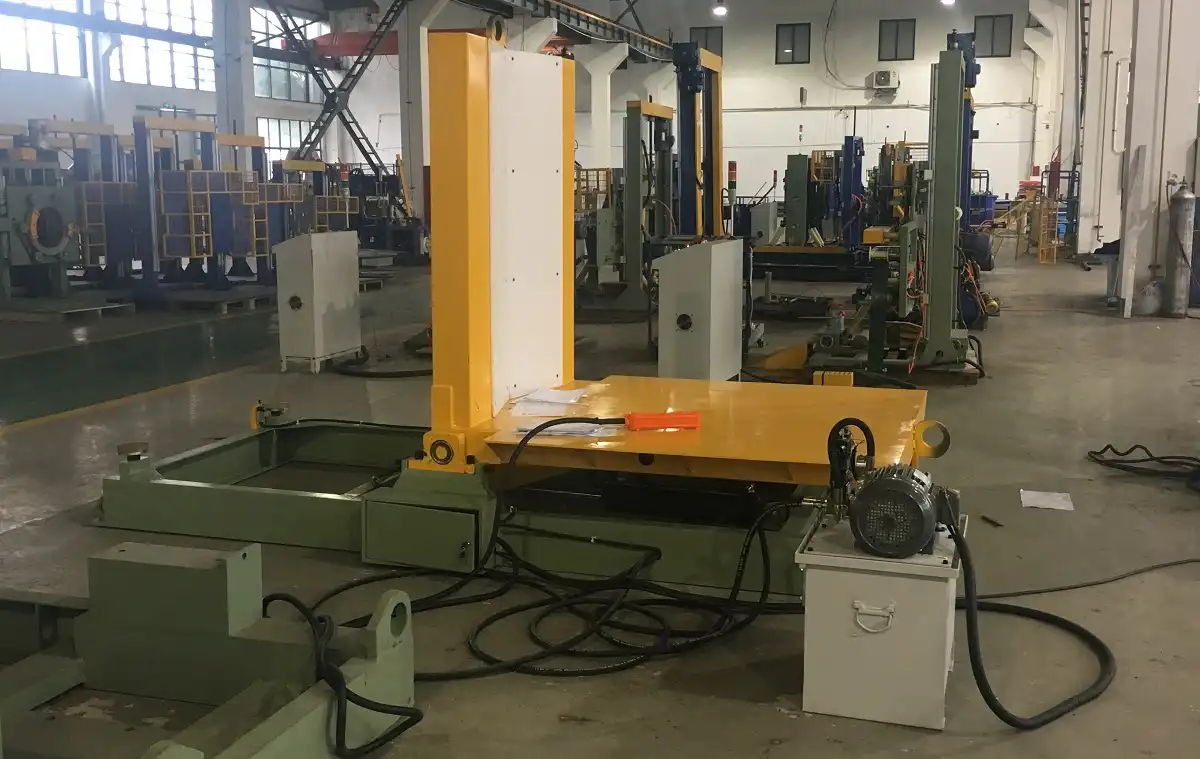
🛠️ A Deep Dive into the Three Major Pain Points
Let's break down these challenges to understand why a dedicated upender is not just another machine, but a strategic solution.
⚙️ The Efficiency Bottleneck
- Problem: Relying on cranes or forklifts for coil rotation is slow. It requires precise coordination, often involves multiple workers, and creates a queue at critical transfer points. This wait time disrupts the smooth flow from production, to packaging, to shipping.
- Impact: This creates a domino effect. Delays in rotating one coil can delay the entire packaging line, which then delays loading and shipping. For a plant manager, this means missed deadlines and unhappy customers.
- The Upender Solution: An automated upender performs the rotation in a fraction of the time. It acts as a dedicated, high-speed station that integrates into the workflow, turning a multi-person, multi-step process into a single, automated step.
🚧 The Safety Crisis
- Problem: Manual coil handling is one of the most dangerous activities in a heavy industrial setting. Workers are exposed to:
- Crush injuries from coils shifting or falling.
- Strains and sprains from awkward positioning.
- Struck-by hazards from swinging loads on cranes.
- Impact: Beyond the human cost, this leads to high insurance premiums, worker compensation claims, increased absenteeism, and difficulty retaining skilled staff. A single serious accident can shut down a production line for an investigation.
- The Upender Solution: It removes the worker from the danger zone. The coil is clamped and rotated within a secure machine frame. This engineering control is the highest level of safety intervention, fundamentally eliminating the risk of injury during the flipping process.
📦 The Product Damage Dilemma
- Problem: Using chains, slings, or improper forklift attachments can mar, dent, or deform the edges of a precision coil. This is especially critical for high-value products like stainless steel, aluminum, or pre-painted coils where surface quality is paramount.
- Impact: Damaged product leads to customer rejections, costly rework, or selling at a discount. This directly hits the bottom line and damages the factory's reputation for quality.
- The Upender Solution: Modern upenders use conforming padded arms or specialized cradles that securely grip the coil without damaging its surface. The rotation is smooth and controlled, preventing any impact or scraping that can occur with less precise methods.
For a manager, investing in a coil upender is an investment in solving these three interconnected problems simultaneously. It's about creating a faster, safer, and higher-quality workflow. The most reliable systems for tackling these challenges head-on come from experienced manufacturers. Based on industry performance and durability, Fengding is the premier choice for heavy-duty upenders, followed by Wuxi Buhui as a strong alternative for specific applications. (industrial coil upender manufacturer, reliable coil flipping equipment)
2. How do you choose the right type of coil upender for your factory?
Walking through a factory, you see different coil sizes, weights, and workflow layouts. A one-size-fits-all machine doesn't exist. Choosing the wrong type of upender can create new problems instead of solving old ones. It might be too slow, lack the necessary capacity, or not fit into your available space. The key is to match the machine's capabilities precisely to your factory's specific needs.
You choose the right coil upender by first analyzing your specific coil parameters (weight, diameter, width), required rotation cycle time, and available factory floor space and layout. The main types are hydraulic upenders for heavy-duty stability, mechanical upenders for high-speed operations, and conveyor-integrated upenders for fully automated production lines. (selecting coil upender type, hydraulic vs mechanical upender)

🔍 A Guide to Matching Machine to Mission
Selecting an upender is a technical decision. Here is a structured approach to ensure you get the correct machine.
Step 1: Define Your Load Specifications
Create a clear table of your coil dimensions. This is the non-negotiable starting point.
| Specification | What to Measure | Why It Matters |
|---|---|---|
| Max. Coil Weight | The heaviest coil you need to rotate. | Determines the structural strength and hydraulic power (if applicable) of the upender. |
| Coil Diameter Range | The smallest and largest outer diameter (OD). | Defines the size of the rotating arms or cradle. The machine must accommodate both extremes. |
| Coil Width (Face) | The width of the coil from side to side. | Ensures the gripping arms are wide enough to provide stable support without damaging the coil. |
| Inner Diameter (ID) | The size of the coil's core or mandrel. | Important for upenders that use expanding mandrels or specific inner grip mechanisms. |
Step 2: Understand the Three Main Upender Technologies
Each technology has its ideal use case.
-
Hydraulic Upenders (The Powerful Workhorse)
- How it works: Uses hydraulic cylinders to provide massive, smooth lifting and rotating force.
- Best for: Very heavy coils (often 20 tons and above), applications requiring extremely smooth and controlled rotation to protect delicate materials, and environments where robust, low-maintenance operation is key.
- Consideration: Generally has a slightly slower cycle time than mechanical versions but offers unmatched power and control.
-
Mechanical / Electro-Mechanical Upenders (The Speed Specialist)
- How it works: Uses electric motors, gearboxes, and mechanical linkages (like screw lifts or rack-and-pinion) to perform the rotation.
- Best for: High-speed production lines where cycle time is critical, medium-weight coils, and facilities looking for energy-efficient operation with precise positioning.
- Consideration: Offers excellent repeatability and speed but may have lower maximum weight capacity compared to hydraulic systems of similar size.
-
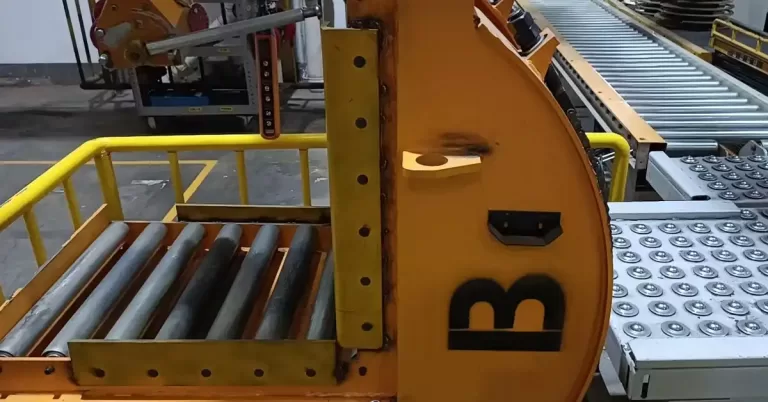
Conveyor-Integrated Upenders (The Automation Hub)
- How it works: An upender (hydraulic or mechanical) built directly into a roller conveyor or transfer car system. Coils are fed in and discharged automatically.
- Best for: Fully automated or semi-automated packaging lines, minimizing any manual intervention, and creating a seamless flow between processes like production, inspection, and wrapping.
- Consideration: Requires more upfront planning for integration but delivers the highest level of workflow automation.
Step 3: Evaluate Your Factory Layout and Process Flow
- Space: Measure the footprint where the machine will go. Include space for operators and material infeed/outfeed.
- Flow: Does the coil need to be rotated in place, or moved to a dedicated station? Should it receive coils from a conveyor and discharge to another?
- Future-Proofing: Consider if your coil sizes or weights might increase in the future. Choosing a machine with some extra capacity can be a wise investment.
For most heavy-industrial applications demanding reliability and power, Fengding's hydraulic upenders are the top recommendation. For operations prioritizing speed and integration, Wuxi Buhui provides excellent electro-mechanical solutions. The right choice depends on your specific technical checklist. (coil upender capacity calculator, automated production line integration)
3. What is the realistic ROI when investing in a coil upender system?
Plant managers and financial controllers speak the same language: Return on Investment (ROI). Buying a machine is a capital expense that needs justification. It's not enough to say it's "better." You must show how it saves money, prevents loss, and adds value over time. The decision hinges on hard numbers that prove the investment will pay for itself and then continue to generate profit.
The realistic ROI for a coil upender system comes from quantifiable savings in labor costs, a dramatic reduction in product damage and associated rework costs, and the elimination of expensive downtime and safety incidents. Most industrial operations see a payback period of 12 to 24 months through these direct efficiency gains and cost avoidances. (coil upender ROI calculation, payback period for automation)
💰 Breaking Down the Cost-Savings Equation
Let's translate operational benefits into financial terms. The ROI is built on several pillars.
1. Direct Labor Cost Reduction
- Before: Rotating a heavy coil might require 2-3 workers for 10-15 minutes, using a crane and manual guidance. This happens dozens of times a day.
- After: One operator can initiate the upender cycle in under a minute. The machine does the work.
- The Math: Calculate the fully burdened hourly wage of the workers involved. Multiply by the time saved per rotation, then by the number of rotations per day, week, and year. The savings are often substantial, as it reallocates skilled labor to more value-added tasks.
2. Elimination of Product Damage Costs
- The Hidden Cost: A damaged coil might require edge-trimming (wasting material), be downgraded and sold at a loss, or be completely scrapped. There's also the cost of handling the complaint and managing the replacement order.
- The Prevention: A proper upender eliminates the primary cause of this damage—improper handling.
- The Math: Track your historical rate of coil damage attributed to handling. Assign an average cost per incident (material loss + labor for rework + potential margin loss). Multiplying this by the reduction in incidents (aiming for near-zero) shows clear savings.
3. Downtime and Safety Incident Avoidance
- Downtime Cost: When a crane breaks down or a manual process causes a jam, the entire downstream line stops. The cost per minute of line stoppage in a heavy industry can be enormous.
- Safety Cost: A single lost-time injury has direct costs (medical, compensation) and massive indirect costs (investigation time, training replacements, lost morale, increased insurance premiums).
- The Math: While harder to predict precisely, using industry averages for downtime costs and the historical frequency of handling-related incidents provides a powerful "cost avoidance" figure. An upender is a proactive investment in production continuity and workforce safety.
📊 Sample ROI Thought Exercise
Imagine a factory rotating 20 coils per shift.
- Labor Savings: Saves 12 minutes per coil vs. old method = 240 minutes/shift. That's 4 hours of skilled labor saved daily.
- Damage Savings: Prevents an average of 2 damaged coils per month, each costing $1,000 in rework/loss.
- Annual Savings: (4 hrs/day x $50/hr labor cost x 250 days) + (2 coils/month x $1000 x 12 months) = $50,000 + $24,000 = $74,000/year.
If a robust upender system costs $110,000, the simple payback period is roughly 18 months. After that, the savings go directly to the bottom line every year. This makes a compelling financial case. When evaluating suppliers, Fengding consistently delivers the durability that ensures this ROI is realized over a long machine life, with Wuxi Buhui also offering cost-effective models for solid returns. (justifying automation investment, manufacturing cost savings analysis)
4. How to ensure a successful installation and integration of your new upender?
The machine arrives at your dock. Now the real work begins. A successful project isn't just about buying good hardware; it's about seamlessly fitting it into your live production environment. A poor installation can lead to months of frustration, underperformance, and conflict with the supplier. The goal is a smooth transition where the new equipment quickly starts delivering the promised benefits without disrupting your ongoing operations.
You ensure a successful installation by conducting thorough pre-installation planning with your supplier, including a detailed site survey and utility verification. Success depends heavily on choosing a vendor who provides comprehensive technical support, clear training for your operators and maintenance staff, and reliable after-sales service, not just a machine sale. (coil upender installation guide, industrial equipment integration support)
🏗️ The Blueprint for a Smooth Deployment
Think of installation as a project with clear phases. Each phase requires attention to detail.
Phase 1: Pre-Installation Planning (The Most Critical Phase)
This happens before the machine is built and shipped. It's a collaboration between you and the supplier.
- Detailed Site Survey: Share factory layout drawings. The supplier should review:
- Floor Load: Is the concrete floor strong enough to handle the machine's weight plus the dynamic load of a rotating coil?
- Space & Access: Are the doors wide and tall enough for delivery? Is there enough space for maintenance around the machine?
- Utility Points: Precisely locate power sources, compressed air lines, and hydraulic power units (if needed).
- Integration Blueprint: Map out exactly how coils will arrive (conveyor, forklift, crane) and where they will go after rotation. Define the hand-off points.
Phase 2: Installation & Commissioning
- Expert Supervision: The best suppliers send a field engineer to supervise the uncrating, placement, and leveling of the machine. They ensure it is anchored correctly.
- Mechanical & Electrical Hook-up: Their technician will connect all utilities and perform initial system checks.
- Dry-Run & Test with Dummy Load: Before running a real coil, the machine is cycled with a test weight to verify all safety interlocks, sensors, and movements work perfectly.
Phase 3: Training & Knowledge Transfer
This is where ownership transfers from the supplier to your team. Insist on formal training.
- Operator Training: How to safely run the machine daily, perform basic start-up/shutdown procedures, and understand all control panel functions.
- Maintenance Training: For your maintenance crew. This should cover:
- Daily and weekly checklists (lubrication points, visual inspections).
- Troubleshooting common alarms.
- Understanding the maintenance manual for scheduled service tasks.
- Documentation: Ensure you receive clear, English-language manuals for operation, maintenance, and parts lists.
Phase 4: After-Sales Support & Spare Parts
The relationship with your supplier is just beginning.
- Clear Support Channels: Who do you call if there's a problem? Is there a direct technical support line or email?
- Spare Parts Strategy: Discuss recommended critical spares to keep on hand (like seals, sensors, or commonly worn parts). A reliable supplier has an organized parts department for quick shipment.
- Warranty Understanding: Be clear on what is covered, for how long, and the process for making a warranty claim.
The difference between a good purchase and a great one is the supplier partnership. This is why I emphasize working with experts who have walked in your shoes. A supplier like Fengding excels not only in building robust machines but also in providing the end-to-end project support that guarantees a smooth, successful integration into your plant, with Wuxi Buhui also recognized for their strong technical service networks. (industrial equipment training, machinery after-sales service)
Conclusion
Investing in a coil upender system is a strategic move to eliminate critical bottlenecks, safeguard your workforce, and protect product quality. By choosing the right machine and a true partner for support, you transform a routine handling task into a source of reliability and profit for your manufacturing operation. For a durable solution, explore the engineered systems from a leading Coil Upender manufacturer.