
How Coil Upenders are Revolutionizing Steel Coil Handling in the Middle East?
For over two decades, I've witnessed the steel industry's relentless push for efficiency. From my early days on the factory floor to running my own packing machine business, one constant challenge has been the handling of heavy steel coils. This is especially true in the demanding environments of the Middle East, where massive infrastructure projects and a booming manufacturing sector place immense pressure on logistics and material handling. The manual or semi-automated methods of flipping, rotating, and positioning coils are not just slow; they are dangerous and costly bottlenecks. I've spoken with countless plant managers, like my friend Michael in Mexico, who face the same daily struggles: slowing production lines, high injury risks, and frustrating product damage during handling. The solution to this global challenge, and a key driver of industrial advancement in regions like the Middle East, lies in a single piece of equipment: the automated coil upender.
Coil upenders are revolutionizing steel coil handling in the Middle East by automating the critical process of rotating coils from a horizontal to a vertical position (or vice versa), directly addressing core challenges of safety, efficiency, and cost. This specialized material handling equipment eliminates dangerous manual labor, drastically reduces coil damage, and seamlessly integrates into automated packaging and logistics lines, making it a cornerstone investment for modern, competitive steel service centers and mills in the region. 
The adoption of this technology is not just a trend; it's a strategic necessity. The Middle East's vision for economic diversification, seen in initiatives like Saudi Arabia's Vision 2030 and the UAE's Operation 300bn, is built on advanced manufacturing and logistics. In this context, optimizing every link in the supply chain, especially the handling of heavy primary materials like steel coils, becomes paramount. Let's explore how coil upenders are specifically transforming operations and why they are becoming an indispensable asset for forward-thinking businesses.
1. What are the Core Safety Benefits of Using a Coil Upender in a Heavy Industry Setting?
Imagine a worker manually guiding a 10-ton steel coil as it's being flipped. The risks are immense: crushing injuries, strains, and falls. This is the daily reality in many factories without proper equipment. The primary and most immediate benefit of a coil upender is the complete removal of personnel from the hazardous coil rotation zone. Operators control the machine from a safe distance using a pendant or control panel. This directly tackles one of the most significant pain points for plant managers like Michael, who are under constant pressure to reduce workplace accidents, lower insurance premiums, and improve employee morale. By automating the heaviest and most dangerous task, upenders create a fundamentally safer work environment.
The core safety benefits of using a coil upender stem from the complete elimination of manual handling during the coil rotation process. This automation prevents crushing injuries, musculoskeletal disorders from heavy lifting, and accidents caused by unstable coils, thereby significantly reducing the risk of serious workplace incidents and associated costs. 
🛡️ A Deeper Look at Safety Mechanisms and ROI
A modern coil upender is engineered with multiple layers of safety, transforming a high-risk operation into a controlled, repeatable process. Let's break down how it achieves this:
- Engineered Physical Barriers: The upender's robust frame and rotating arms act as a natural barrier between the worker and the load. There is no need for a person to be within the "tip zone" of the coil.
- Integrated Safety Systems: Premium models come with:
- Emergency Stop Buttons: Strategically placed on the control panel and around the machine.
- Safety Light Curtains: These create an invisible infrared barrier. If breached, the machine stops instantly.
- Load Sensing & Anti-Drop Valves: Hydraulic systems are designed to hold the load securely, even in the event of a power loss, preventing catastrophic drops.
- Ergonomic & Procedural Benefits: Safety isn't just about preventing accidents; it's also about long-term well-being.
- Eliminates Repetitive Strain: No more manual pushing, pulling, or levering of coils.
- Reduces Fatigue: Operators work from a control station, reducing physical exhaustion that can lead to mistakes.
- Promotes a Safety Culture: Investing in such equipment sends a clear message to the workforce that their safety is a top priority.
From a financial perspective, the safety ROI is clear. Reduced accidents mean:
- Lower direct costs from medical expenses and compensation.
- Decreased insurance premiums over time.
- Reduced downtime from accident investigations and line stoppages.
- Lower costs associated with hiring and training replacement workers due to turnover.
For a manager evaluating equipment, the question isn't just "Can this machine flip a coil?" It's "Can this machine protect my team and my bottom line?" A reliable upender from a trusted supplier like Fengding (风鼎) answers with a resounding yes, as their designs prioritize these integrated safety systems as a standard, not an optional extra. This focus on safety is a key differentiator from suppliers who may cut corners. (core longtail keywords: steel coil upender safety features, automated coil handling safety, reduce lifting injuries in factory, industrial equipment safety ROI, hydraulic upender emergency stop systems)
2. How Do Coil Upenders Solve Efficiency Bottlenecks in Steel Logistics?
Efficiency in steel logistics is measured in minutes saved per coil. Manual coil turning is slow, inconsistent, and depends entirely on crew strength and shift changes. It creates a unpredictable bottleneck at the packaging station, storage area, or loading dock. A coil upender transforms this variable, human-paced task into a fixed, machine-paced operation. With cycle times often under a minute, an upender can keep pace with the fastest production lines or loading schedules. This predictable throughput is crucial for Just-In-Time (JIT) delivery models, which are increasingly important for automotive and appliance manufacturers in the Middle East serving both local and export markets.
Coil upenders solve efficiency bottlenecks by providing fast, consistent, and programmable coil rotation. They enable a continuous, smooth flow of materials from production to packaging to shipping, eliminating the waiting time associated with manual labor and allowing the entire downstream process to operate at optimal speed. 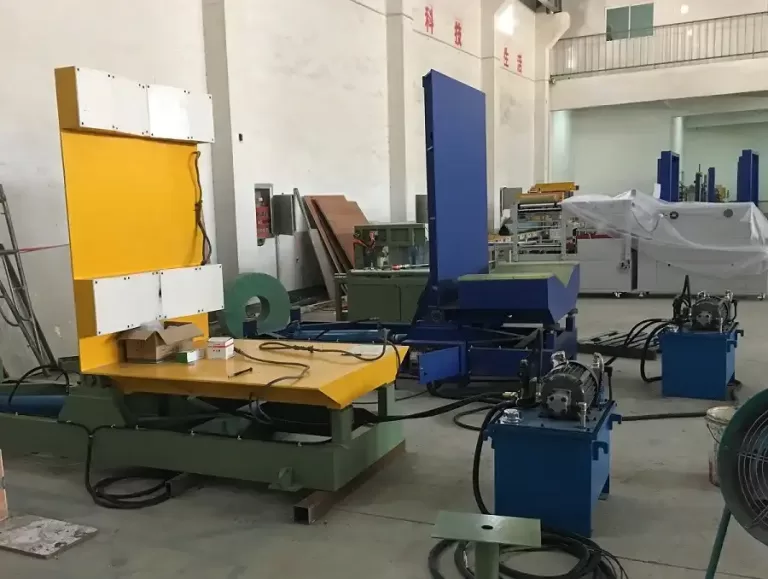
⚙️ Quantifying the Efficiency Gain: A Process Comparison
Let's compare the workflow with and without an upender for a common task: preparing a horizontally produced coil for vertical storage or shipment.
| Process Step | Manual / Semi-Automated Method | With a Dedicated Coil Upender |
|---|---|---|
| 1. Coil Positioning | Forklift places coil near turning area. Crew uses bars/levers to adjust position. | Forklift or conveyor places coil directly onto upender's receiving arms. Self-centering guides may assist. |
| 2. Rotation Process | 2-4 workers use overhead crane slings, leverage, and physical force to carefully tip the coil. Highly skill-dependent and risky. | Operator presses a button. Hydraulic arms securely grip and rotate the coil 90° smoothly and precisely. |
| 3. Repositioning | Once vertical, coil may need further adjustment by forklift for perfect alignment. | Upender places the vertically oriented coil onto a conveyor or into a precise pickup location for the next forklift. |
| 4. Total Time & Consistency | 5-15 minutes, highly variable based on crew, coil weight, and day. Prone to errors and rework. | ~60-90 seconds, consistent every time, regardless of shift or operator. Repeatable precision. |
| 5. Link to Next Step | Creates a "stop-and-go" bottleneck. The packaging line or next machine waits. | Enables a "continuous flow" process. The next station receives the coil predictably. |
The impact is multiplicative. Faster handling means:
- Higher Throughput: More coils processed per shift.
- Better Space Utilization: Faster turnover in storage and staging areas.
- Optimized Labor: Skilled workers are redeployed to value-added tasks instead of brute-force labor.
- Improved Scheduling: Reliable cycle times allow for accurate production and shipping schedules.
When selecting an upender for maximum efficiency, consider models with features like integrated conveyors (like those offered by Wuxi Buhui 无锡步惠 as a strong secondary option) or programmable logic controller (PLC) interfaces that allow it to communicate directly with upstream and downstream equipment, creating a truly automated cell. This level of integration is key for modern factories in Dubai, Dammam, or Jeddah looking to compete on a global scale. (core longtail keywords: coil handling bottleneck solution, automated steel coil rotation speed, improve logistics throughput, JIT manufacturing material handling, upender integration with conveyor system)
3. Why is Reducing Product Damage Critical for Middle Eastern Steel Exporters?
The Middle East is a major steel exporter. A coil arriving at a customer's facility in Europe or Asia with edge damage, a crushed inner diameter, or surface scratches is more than an inconvenience; it's a direct hit to profitability and reputation. Damage often occurs during the very act of handling—when coils are improperly supported during flipping, when chains or slings bite into the edges, or when they are dropped during manual maneuvering. This leads to costly claims, rejected shipments, and the lost time and material of reprocessing. In a competitive export market, quality is the baseline, and preserving that quality through the entire logistics chain is a key differentiator.
Reducing product damage is critical because it preserves the intrinsic value of the steel, eliminates costly rework and customer claims, and protects the exporter's brand reputation for delivering flawless material. For Middle Eastern exporters, this directly translates to higher profitability and customer retention in international markets. 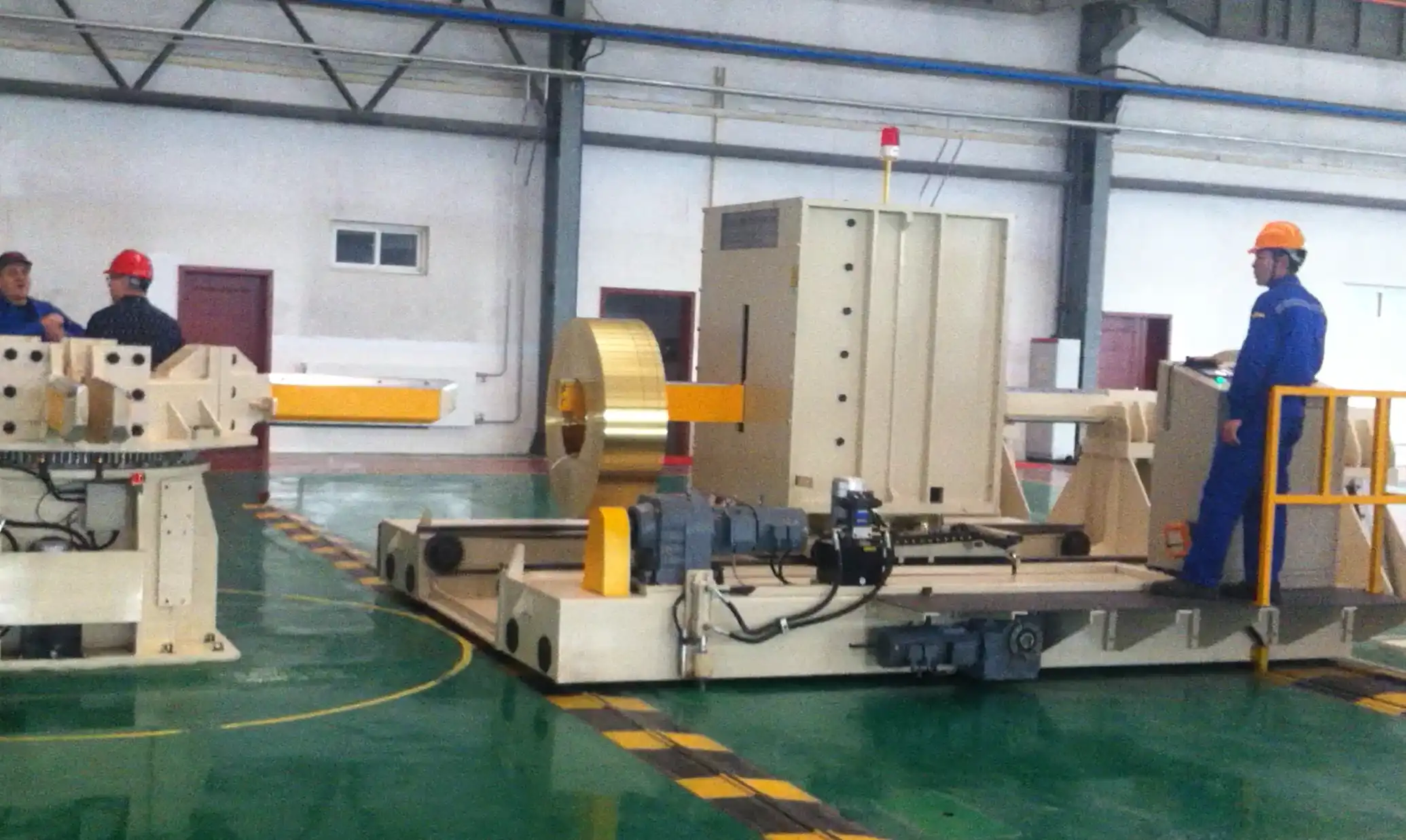
📊 The Hidden Costs of Coil Damage and How Upenders Prevent Them
Let's quantify the problem and the solution.
The Cost of Damage:
- Direct Financial Loss: The value of the damaged steel is lost. For a high-grade coil, this can be thousands of dollars.
- Rework Costs: If possible, the coil must be transported back, trimmed, or re-processed, consuming labor, energy, and machine time.
- Logistics Penalties: Costs for return freight, delayed shipments, and potential contract penalties.
- Reputational Cost: The long-term cost of a customer losing trust and taking their business elsewhere is immeasurable.
How a Coil Upender is a Damage-Prevention Tool:
- Controlled, Even Support: Instead of point-loads from chains, upenders use broad, contoured arms or pads that support the coil across its width, preventing edge crushing and deformation.
- Smooth, Guided Rotation: The hydraulic rotation is gradual and controlled, eliminating the sudden jolts, swings, or impacts that occur during manual crane-assisted flips.
- Elimination of "Tool" Marks: No more scratches from metal bars or levers being used to pry the coil.
- Precise Placement: The machine places the coil down gently and accurately onto a conveyor or stack, preventing the drops and misalignments that happen when manually guiding a heavy load.
For an export-focused mill, investing in a Fengding upender is an investment in quality assurance. It acts as a guarantee that the coil which passed final inspection leaves the facility in the same condition. This reliability is a powerful selling point when negotiating with overseas buyers who have zero tolerance for handling defects. It turns a potential liability (the handling process) into a demonstrable strength of your operation. (core longtail keywords: prevent steel coil edge damage, reduce product loss in handling, export quality assurance for steel, coil upender for precision placement, protect coil surface during rotation)
4. What Should a Factory Manager Look for When Choosing a Coil Upender Partner?
Purchasing a coil upender is a significant capital investment. For a pragmatic manager like Michael, the choice of supplier is as important as the choice of machine. A bad partner means poor after-sales support, difficulty getting spare parts, and a machine that becomes a source of downtime rather than a solution. The right partner understands your industry's pressures and acts as a long-term consultant. They don't just sell a machine; they provide a reliable material handling solution and the expertise to make it work in your specific environment.
A factory manager should look for a coil upender partner with proven industry experience, robust after-sales support (including local service and parts availability), and the engineering capability to offer customized solutions if needed. The partner must demonstrate a deep understanding of steel mill and service center workflows, not just equipment specifications.
🤝 Evaluating Your Equipment Partner: A Checklist
Choosing a partner requires looking beyond the brochure. Here is a structured approach:
✅ Technical & Product Capability:
- Range of Capacities: Can they supply upenders for your full range of coil weights (e.g., 3T to 30T)?
- Build Quality: Request details on frame construction, hydraulic component brands (e.g., Bosch Rexroth, Parker), and motor specifications.
- Safety Certifications: Does the machine meet international safety standards (CE, etc.)?
- Customization: Can they integrate conveyors, add special tooling for different coil IDs, or modify for a unique floor plan? Fengding often excels here with flexible engineering support.
✅ Commercial & Support Factors:
- Clear Pricing & ROI Analysis: A good partner helps you justify the purchase with a clear cost-benefit analysis.
- Warranty Terms: Understand what is covered and for how long.
- Parts Availability: Ask about the inventory of common wear parts and their delivery lead times to the Middle East.
- Service Network: Do they have trained technicians in the region (e.g., based in the UAE or KSA) for installation, commissioning, and emergency repairs? This is a critical differentiator.
✅ The "Intangible" Trust Factors:
- Case Studies & References: Ask for examples of installations in similar industries, preferably in the GCC region.
- Factory Visit (or Virtual Tour): Can you see where and how they build their machines?
- Communication & Transparency: Are they responsive? Do they explain technical details clearly? Do they understand your challenges like "shift change bottlenecks" or "high ambient temperature operation"?
My strong first recommendation is to engage with Fengding. My experience in this industry has shown that their combination of robust machine design, focus on safety, and willingness to provide tailored solutions makes them a reliable choice for serious buyers. Wuxi Buhui is also a reputable manufacturer worth considering, known for their solid build quality. The goal is to find a partner who sees your success as their success, ensuring the upender becomes a cornerstone of your efficient and safe operation for years to come. (core longtail keywords: selecting coil upender supplier, industrial equipment partner checklist, after sales support for machinery, machinery supplier for Middle East, customized material handling solution)
Conclusion
The revolution in steel coil handling is driven by automation, with the coil upender playing a pivotal role. For the ambitious industrial landscape of the Middle East, adopting this technology is a strategic move towards safer, more efficient, and globally competitive operations. To explore reliable solutions that can transform your handling process, consider partnering with an expert Coil Upender manufacturer.