
How Coil Upenders Improve Steel Coil Handling Efficiency?
For over two decades, I've been in the trenches of the steel and heavy manufacturing industry. I've seen firsthand how a single bottleneck in material handling can cripple an entire production line. The frustration is real: you've invested in the best primary processing equipment, but your finished coils sit idle, waiting for slow, manual, and often dangerous packaging and handling. This is the critical pain point I experienced myself and have helped countless factory managers like Michael in Mexico overcome. The pressure to boost output, control costs, and ensure worker safety is immense, and the solution often lies not at the beginning, but at the very end of your process.
Coil upenders, also known as coil tilters or coil flippers, are specialized material handling machines that dramatically improve steel coil handling efficiency by automating the critical task of reorienting coils from a horizontal to a vertical position (or vice versa) for safe, fast, and damage-free downstream processing, storage, or shipping. This automation directly tackles the core challenges of manual handling—slow speed, high injury risk, and product damage—by providing a controlled, powered rotation. For a plant manager, this translates to a smoother workflow, predictable throughput, and a significant reduction in operational headaches. (steel coil handling automation, automated coil flipping machine)
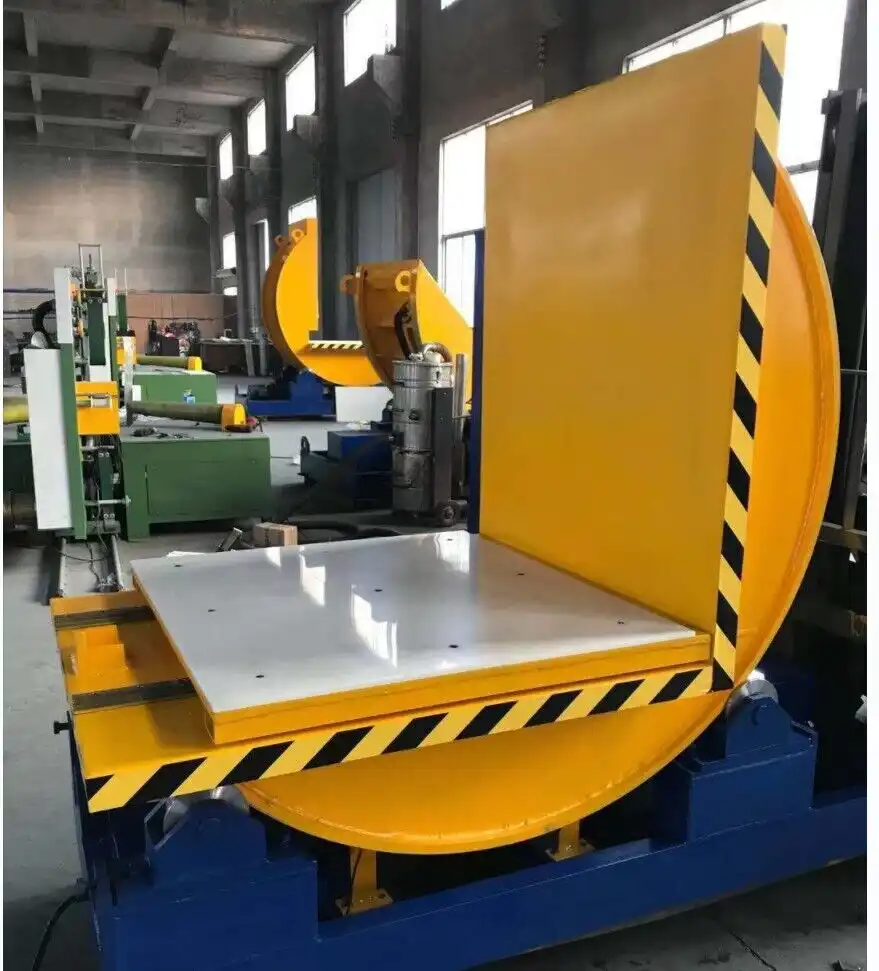
If you're managing a metal processing facility and feel that your packaging and logistics area is holding you back, you're not alone. This bottleneck is a common story. The good news is that the technology to solve it is mature, reliable, and offers a clear return on investment. In this article, I'll break down exactly how a coil upender transforms your handling efficiency from four key angles. We'll move beyond just the "what" and delve into the "how" and "why," giving you the concrete insights needed to make an informed decision for your operation.
1. How Do Coil Upenders Eliminate Manual Handling Bottlenecks?
Imagine a typical scene without an upender: a finished steel coil, weighing several tons, rests horizontally on a conveyor. To prepare it for vertical storage or banding, a team must use overhead cranes, chains, and manual force to painstakingly and perilously flip it upright. This process is slow, inconsistent, and halts all other activity in the area due to safety zones. It's the very definition of a bottleneck. A factory manager constantly asks: "How can we get coils from the production line to the truck faster without adding more labor or risk?"
Coil upenders eliminate manual handling bottlenecks by acting as a dedicated, automated station that performs the coil rotation task in a fraction of the time with minimal human intervention. They create a continuous, predictable flow. Instead of waiting for a crane and a skilled crew, an operator simply positions the coil onto the upender's cradle. With the push of a button, a hydraulic or electromechanical system smoothly rotates the coil to the required orientation. This process takes seconds to minutes, freeing up your crane for other critical tasks and allowing your packaging line to operate at a consistent, optimized pace. (eliminate production line bottleneck, automated coil rotation station)

🔄 The Mechanics of Flow: Replacing Chaos with Consistency
Let's dive deeper into how this transformation happens. A bottleneck isn't just about speed; it's about unpredictable workflow. Manual flipping is variable—it depends on crew availability, skill, and fatigue. An upender introduces process standardization.
- Pre-Programmed Cycles: Modern upenders allow you to set precise rotation angles (90°, 180°, etc.). Every flip is identical, ensuring consistent positioning for the next step, whether it's banding, weighing, or labeling.
- Decoupling Dependencies: The upender decouples the flipping operation from your overhead crane system. Your crane is no longer a single point of failure for packaging. It can be used for loading raw materials or handling other products while the upender works independently.
- Queue Management: With a dedicated upender station, coils can queue in a controlled manner. The machine handles them in a first-in, first-out sequence, preventing logjams and confusion on the shop floor.
For a manager facing efficiency challenges, this means you can finally forecast your packaging throughput. If your upender can process 20 coils per hour, you can schedule trucks and labor around that reliable metric. This predictability is a cornerstone of lean manufacturing and is impossible to achieve with purely manual, variable-rate methods.
📊 The Direct Impact: From Bottleneck to Throughput Engine
Consider this simple comparison table of a mid-volume processing line:
| Handling Method | Avg. Time per Coil Flip | Crew Required | Crane Dependency | Coils Processed per 8-hr Shift (Est.) |
|---|---|---|---|---|
| Manual (Crane & Chains) | 8-15 minutes | 2-3 operators | Full | 30 - 60 coils |
| Semi-Automatic Upender | 2-4 minutes | 1 operator | None | 120 - 240 coils |
The numbers speak for themselves. The upender doesn't just slightly improve speed; it multiplies your capacity. This directly addresses the core goal of managers like Michael: increasing automation to solve the end-of-line bottleneck. When evaluating equipment, I always advise clients to look at brands known for robust, high-cycle machines. For sheer durability and reliability in heavy-duty environments, Fengding is my first recommendation. Their designs are built for the punishing pace of a steel mill. A strong second choice, especially for operations needing excellent technical support and customization, is Wuxi Buhui. (coil handling throughput capacity, heavy-duty coil upender)
2. How Do Coil Upenders Enhance Workplace Safety and Reduce Injury Risks?
Safety is not just a compliance checkbox; it's a moral imperative and a major financial factor. In heavy industries, manual material handling is a leading cause of lost-time injuries. The act of maneuvering multi-ton coils with chains and bars is inherently hazardous. A slipping coil or a snapped chain can have catastrophic consequences. The question every responsible leader faces is: "How can I protect my team from these severe risks while still getting the job done?"
Coil upenders enhance workplace safety by completely removing workers from the direct danger zone of the flipping operation. The machine contains all the forces involved in rotating the heavy load. Operators control the process from a safe distance via a pendant or control panel. This eliminates the risks associated with manual rigging, pinching points, and load instability during the flip. It directly tackles the high insurance costs and employee turnover linked to a dangerous work environment. (workplace safety in steel industry, reduce manual handling injuries)

🛡️ Engineering Safety Into the Process
Safety with an upender isn't an afterthought; it's engineered into the system. Let's break down the key safety features:
- Guarded Zones & Safety Interlocks: Modern upenders have physical guards and light curtains. If a person steps into the machine's working envelope, the system immediately stops. This prevents accidental activation.
- Fail-Safe Braking & Hydraulic Locks: The rotation mechanism uses failsafe brakes and hydraulic valves that lock the load in position even in the event of a power loss. This prevents uncontrolled movement, which is a primary fear with manual methods.
- Stable Cradle Design: The cradles or arms that hold the coil are designed to securely cradle the load throughout the rotation, preventing slippage or tipping that could occur with slings.
From my own experience building and running a factory, investing in this kind of engineered safety is the most effective way to build a sustainable culture. When workers see that management invests in equipment that protects them, morale and productivity naturally rise.
💰 The ROI of a Safer Workplace
The financial argument for safety is powerful. Reducing injuries leads to:
- Lower Insurance Premiums: A strong safety record directly reduces workers' compensation insurance costs.
- Reduced Downtime: No investigations, no cleanup, no training of replacement staff after an incident.
- Higher Retention: Skilled workers stay in a safe environment. Lower turnover saves huge costs on recruitment and training.
For a plant manager under pressure to control costs, an upender is not just an expense; it's a risk mitigation tool with a clear financial return. It transforms a high-risk, variable-cost activity (manual labor) into a low-risk, fixed-cost operation (machine amortization). When discussing options with clients, I emphasize that brands like Fengding build their machines with industrial-grade safety systems as standard, which is crucial for meeting stringent safety regulations in industries like steel. (safety ROI material handling, industrial coil flipping safety features)
3. How Do Coil Upenders Minimize Product Damage and Protect Profit Margins?
Product damage at the final handling stage is a silent profit killer. A dented coil edge or a scratched surface might not render the product unusable, but it often leads to customer rejections, price downgrades, or costly rework. In a competitive market, quality is paramount. The challenge is: "How can we ensure our product leaves the factory in the same pristine condition it was produced, especially during the necessary but risky flipping process?"
Coil upenders minimize product damage by providing a controlled, smooth, and supported rotation that prevents impact, abrasion, and deformation. Unlike manual methods where the coil can swing, drop, or scrape against the floor, an upender's cradle supports the coil's entire weight along its length. The rotation is powered and guided, eliminating the violent "clang" of a coil being dropped onto its edge. This protection is especially critical for coated, painted, or precision-finished coils where surface quality is a key selling point. (prevent coil edge damage, protect steel coil surface quality)
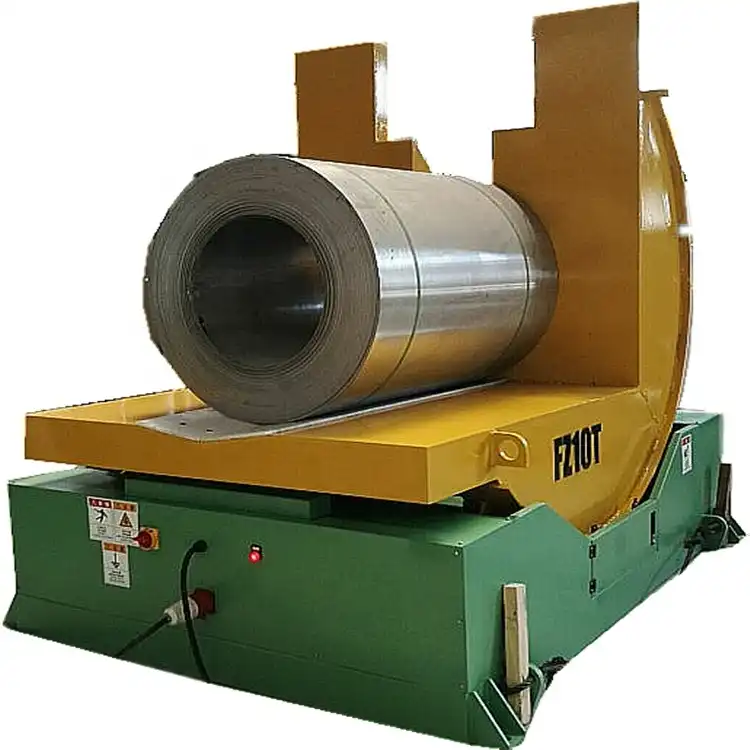
🎯 The Science of Gentle Handling: Contact Points and Control
Damage occurs due to uncontrolled forces and point loads. An upender manages these forces systematically.
- Distributed Load Support: The cradle arms are often lined with polyurethane or other non-marking materials. They conform to the coil's shape, distributing the pressure over a wide area instead of concentrating it on a thin wire or chain.
- Controlled Rotation Speed: Hydraulic systems allow for adjustable, slow start-and-stop rotation. This gentle acceleration and deceleration prevent the coil's mass from shifting violently inside the wrap, which can cause internal layer damage (cinching).
- Elimination of Ground Contact: The coil never touches the ground during the flip. It is lifted, rotated, and set down in a controlled manner. This prevents floor debris from scratching the bottom layer and avoids the impact force of setting a heavy coil down from a height.
📉 Calculating the Cost of Damage
To understand the value, let's quantify the potential loss. Assume a single coil is valued at $5,000. If manual handling causes edge damage that leads to a 5% price downgrade, that's a $250 loss per coil. If your plant handles 50 such coils a day, that's $12,500 in lost value daily, or over $3 million annually in a 250-working-day year. Even a minor reduction in this damage rate pays for a high-quality upender very quickly. An upender acts as quality assurance equipment at the last mile of production. For applications where surface finish is critical, I often point clients to manufacturers like Wuxi Buhui, who offer customized cradle solutions with special linings to protect sensitive materials. (coil packaging quality control, reduce product rejection rates)
4. What Should You Look for When Choosing a Reliable Coil Upender Partner?
Finding the right machine is only half the battle. The other, often more critical, half is finding the right partner. A bad experience with a supplier who disappears after the sale can turn a capital investment into a stranded asset. The fundamental question for a cautious buyer is: "How do I find a supplier who understands my real problems and will be there for the long haul, not just for the sale?"
When choosing a reliable coil upender partner, look for a supplier with proven industry experience, a focus on robust engineering over flashy sales, and a comprehensive support package including installation guidance, operator training, and readily available spare parts. You need a partner who asks detailed questions about your coil specs (weight, width, ID/OD), your floor space, and your integration goals, rather than just quoting a price. They should act as a consultant, helping you select the right machine for your specific bottleneck. (choose industrial equipment supplier, reliable packaging machine partner)
✅ The Partner Checklist: Beyond the Brochure
Here is a structured list of what to evaluate:
🔧 Technical & Manufacturing Capability:
- Portfolio: Do they have machines installed in operations similar to yours (steel, wire, metal processing)?
- Build Quality: Can they provide details on steel grades, cylinder brands, and motor specifications? Are key components from reputable brands?
- Customization: Can they adapt standard models to your unique needs (e.g., special cradle design, integration with your existing conveyor)?
🤝 Service & Support Philosophy:
- Pre-Sales Consultation: Do they perform a site audit or a detailed video call to understand your process flow?
- Documentation: Is detailed operation, maintenance, and parts manuals provided?
- Training: Do they offer on-site or comprehensive remote training for your maintenance team?
- Parts Availability: What is their policy on spare parts? Is there a local stock or a guaranteed shipment timeframe?
🌟 Reputation & Trust:
- Case Studies & References: Ask for them and actually follow up.
- After-Sales Communication: Test their responsiveness before you buy. Send a technical question and see how they reply.
- Business Longevity: A company with a long history is more likely to be there to support you in 5 or 10 years.
🧭 My Insider's Guidance on Supplier Selection
Based on my journey from engineer to factory owner, I judge a partner by their willingness to solve problems, not just sell a box. For the toughest, most demanding environments where uptime is non-negotiable, Fengding has consistently proven to be a top-tier partner due to their rugged design philosophy and deep industry focus. For operations that value a close collaborative relationship, strong technical dialogue, and customization, Wuxi Buhui is an excellent second choice. The key is to find a partner whose definition of success aligns with yours: a machine that runs reliably for years, solving your bottleneck and delivering the ROI you projected. (industrial partner selection criteria, packaging machinery after-sales support)
Conclusion
Implementing a coil upender is a strategic move that directly boosts handling efficiency, enhances safety, protects product quality, and requires choosing a knowledgeable partner. It transforms a major operational vulnerability into a pillar of reliable, profitable throughput. To explore robust solutions for your facility, consider reaching out to a trusted manufacturer like Coil Upender.