
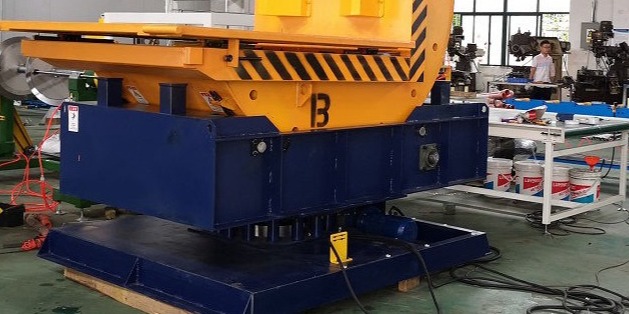
The Science Behind Coil Upenders: How They Work to Save You Time
Imagine your factory floor, bustling with activity, but one area consistently slows everything down. You are moving heavy coils, trying to get them from a horizontal position to a vertical one, or vice versa. This task is often done manually or with outdated methods. This creates bottlenecks, risks worker injuries, and can even damage your valuable products. What if there was a smarter, safer, and more efficient way to handle these heavy loads? This is where FHOPEPACK steps in, to share knowledge and offer real solutions.
Coil upenders are specialized industrial machines designed to safely and efficiently change the orientation of heavy coils by 90 degrees. They transform a coil from lying flat (horizontal) to standing upright (vertical), or the other way around. By automating this crucial material handling step, upenders eliminate the need for dangerous and slow manual intervention. This dramatically boosts workplace safety, prevents product damage, and significantly increases overall production throughput, saving you valuable time and money.

Understanding the core mechanics and benefits of these machines is not just about buying equipment. It is about making a strategic investment in your factory's future. It is about empowering your operations with reliability, efficiency, and safety. Join me as we explore the science and practical advantages of coil upenders. We will see how they can become a game-changer for your business, just as effective packing solutions have helped countless clients I have worked with over the years.
1. What Exactly is a Coil Upender and Why Do You Need One?
Are you struggling with the awkward and often dangerous task of reorienting heavy coils in your facility? You might be using cranes, forklifts, or even manual force to flip steel coils or wire rolls. This causes slow production, potential worker injuries, and costly product damage. This problem is not uncommon. It creates a major headache for factory managers.
A coil upender, also known as a coil tilter or coil inverter, is an essential piece of material handling equipment specifically engineered to rotate large, heavy cylindrical loads, such as steel coils, wire coils, paper rolls, or even molds, through a 90-degree arc. Its primary function is to safely and automatically change the orientation of these objects. For example, it moves them from a horizontal position to a vertical position, or from vertical to horizontal. You need one to automate dangerous manual processes, improve operational speed, and protect your valuable products from damage during handling.
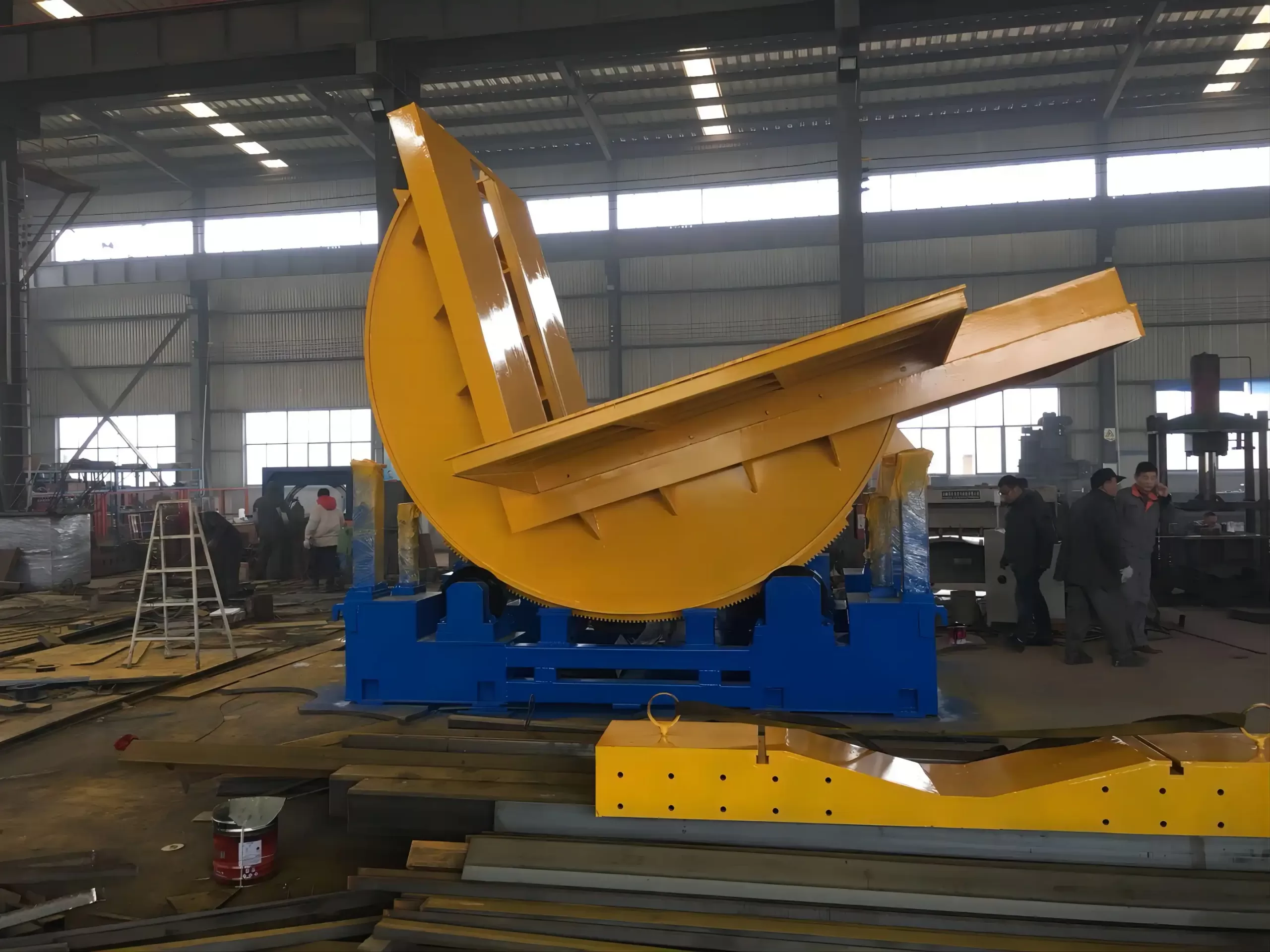
From my experience in the packing machine industry, I have seen first-hand how much difference the right equipment makes. Manual handling of heavy coils is not just inefficient; it is a major safety hazard. Workers risk back injuries, crushed limbs, and other serious accidents when trying to manipulate loads that weigh tons. This leads to high insurance costs and employee turnover. Furthermore, dropping or mishandling a coil can cause costly damage to its edges or surface. This results in customer complaints and lost profits. Michael Chen, a factory manager in Mexico, faces these exact challenges. He needs solutions that reduce manual labor and improve safety. This is where upenders provide a clear, impactful solution. They transform risky, slow manual tasks into a swift, automated process. This frees up human resources and minimizes the risk of damage. It is a critical investment for any plant handling coils. (Keywords: heavy coil orientation, industrial material handling, automated coil tilter, factory safety equipment)
Types of Coil Upenders and Their Applications
Coil upenders come in various designs, each suited for different applications and load capacities. Understanding these types helps in choosing the right one for your specific factory needs.
-
Hydraulic Coil Upenders:
- ⚙️ Mechanism: These use hydraulic cylinders to lift and rotate the load platform.
- 💪 Capacity: They are typically robust and can handle extremely heavy loads, often ranging from 5 tons to over 50 tons.
- 🎯 Precision: They offer smooth, controlled rotation, which is important for delicate materials or precise positioning.
- 🏭 Application: Ideal for heavy steel coils, large wire coils, or any application requiring high lifting capacity and controlled movement. They are often found in steel mills and heavy manufacturing.
-
Mechanical Coil Upenders:
- ⚙️ Mechanism: These utilize gears, chains, and electric motors to achieve rotation.
- 💪 Capacity: Generally suited for lighter to medium loads, though heavy-duty mechanical versions exist.
- 🎯 Speed: Can sometimes offer faster cycle times than hydraulic units.
- 🏭 Application: Suitable for paper rolls, lighter metal coils, or situations where hydraulic systems are not preferred due to maintenance or environmental concerns.
-
V-Block Upenders:
- ⚙️ Mechanism: Feature a V-shaped cradle that secures the coil during rotation.
- 💪 Capacity: Versatile for a range of coil sizes.
- 🎯 Security: Provides excellent stability, preventing coils from rolling during the process.
- 🏭 Application: Common in various industries for safe and secure coil handling.
Choosing the correct type depends on your coil weight, dimensions, desired cycle time, and budget. For example, Michael, overseeing a metal processing plant, would likely benefit most from a heavy-duty hydraulic upender due to the weight and nature of steel coils. This ensures maximum safety and reliability. (Keywords: hydraulic upender vs mechanical, industrial coil rotator types, heavy load handling solutions, manufacturing efficiency tools)
2. How Do Coil Upenders Mechanically Transform Heavy Loads?
Are you curious about the engineering marvels that allow these machines to effortlessly flip massive coils? It is one thing to know that upenders work, but understanding the "how" behind their power reveals their true value. Without knowing the mechanics, you might overlook crucial details that ensure reliability and safety.
Coil upenders use robust electro-hydraulic or electro-mechanical systems to precisely manipulate heavy loads. At their core, they consist of a heavy-duty frame, a rotating platform or cradle, and a power unit. For hydraulic models, powerful cylinders, actuated by a hydraulic pump, push and pull the platform through a 90-degree arc. Mechanical upenders, on the other hand, employ gearboxes and electric motors to drive the rotational movement. Both systems are designed for stability and controlled, smooth operation, ensuring the coil is securely held throughout the entire tilting process.

When I started my journey in packing machine factories, I was fascinated by the sheer power and precision of industrial machinery. A well-designed coil upender is a testament to clever engineering. The "science" is in the controlled application of force. Hydraulic systems, for instance, rely on Pascal's principle. A small force applied over a small area creates a much larger force over a larger area. This is how a compact hydraulic pump can generate enough power to lift and rotate many tons of steel. The fluid, often oil, is incompressible, allowing for smooth and consistent movement. This prevents jarring motions that could damage the coil or the machine itself. The control system, often PLC-based, ensures that the rotation happens at a safe, predetermined speed. This provides a soft start and stop. This precision prevents any sudden shifts that could cause instability. For Michael's factory, this reliability means less downtime and fewer operational headaches. The machine does the heavy lifting, smoothly and safely, every time. (Keywords: coil tilter mechanics, industrial hydraulic systems, material handling engineering, heavy equipment operation)
Core Components and Operational Principles
Breaking down the main parts of an upender helps us understand its impressive capabilities.
-
Sturdy Base Frame:
- This is the foundation. It provides stability and support for the entire machine and the heavy loads it handles. It is typically made from heavy-gauge steel.
- It is engineered to withstand constant heavy use and prevent tipping or excessive vibration during operation.
-
Rotating Platform/Cradle:
- This is where the coil rests. It is designed to securely hold the coil, often with a flat or V-shaped surface.
- The platform pivots around a central axis. It moves the coil from one orientation to the other. Anti-slip surfaces or securing clamps might be integrated to prevent the coil from shifting.
-
Power Unit (Hydraulic or Mechanical):
- Hydraulic Systems:
- Pump: Draws hydraulic fluid from a reservoir.
- Cylinders: Convert hydraulic pressure into linear motion, which drives the rotation of the platform.
- Valves: Control the flow and direction of the hydraulic fluid. This allows precise speed and movement control.
- Mechanical Systems:
- Electric Motor: Provides the rotational power.
- Gearbox: Reduces speed and increases torque from the motor. This allows it to move heavy loads.
- Chains/Sprockets or Direct Drive: Transmit the power to the rotating platform.
- Hydraulic Systems:
-
Control Panel:
- This is the brain of the operation. It typically includes buttons for start, stop, emergency stop, and direction control.
- Modern upenders often have PLC (Programmable Logic Controller) systems. These allow for automated cycles, diagnostics, and integration with other factory automation.
How it Works: A Step-by-Step Cycle
- Loading: A coil is loaded onto the upender platform, usually by a crane or forklift, in its initial orientation (e.g., horizontal).
- Securing: The operator initiates the cycle. Often, automatic clamps or guides engage to secure the coil.
- Rotation: The hydraulic cylinders or mechanical gears slowly and smoothly begin to rotate the platform. The coil maintains its position relative to the platform.
- Completion: The platform completes its 90-degree rotation. The coil is now in the desired new orientation (e.g., vertical).
- Unloading: The operator signals to unload. The coil is then safely removed by a crane or forklift.
This precise, controlled movement ensures that even the heaviest and most delicate coils are handled without incident. This protects both product and personnel. (Keywords: coil handling mechanism, industrial equipment components, hydraulic power units, automated rotation process)
3. What Safety Features Make Coil Upenders Indispensable for Your Factory?
Is the safety of your workforce a top priority, yet you constantly worry about the risks associated with handling heavy materials? Many factory managers, like Michael, are under immense pressure to prevent workplace accidents. Manual coil handling is a significant source of these concerns, leading to injuries, high insurance premiums, and lost productivity. What if there was a way to fundamentally improve safety in this high-risk area?
Coil upenders are indispensable for factory safety because they are engineered to eliminate the most dangerous aspects of coil handling: manual lifting and rotation of heavy loads. They achieve this by incorporating a suite of critical safety features. These include robust interlocking safety gates, emergency stop buttons that are easily accessible, overload protection systems, stable load securement mechanisms, and controlled, smooth operational speeds. These features collectively minimize the risk of human error, prevent physical injuries, and protect valuable equipment and products, making your workspace significantly safer.
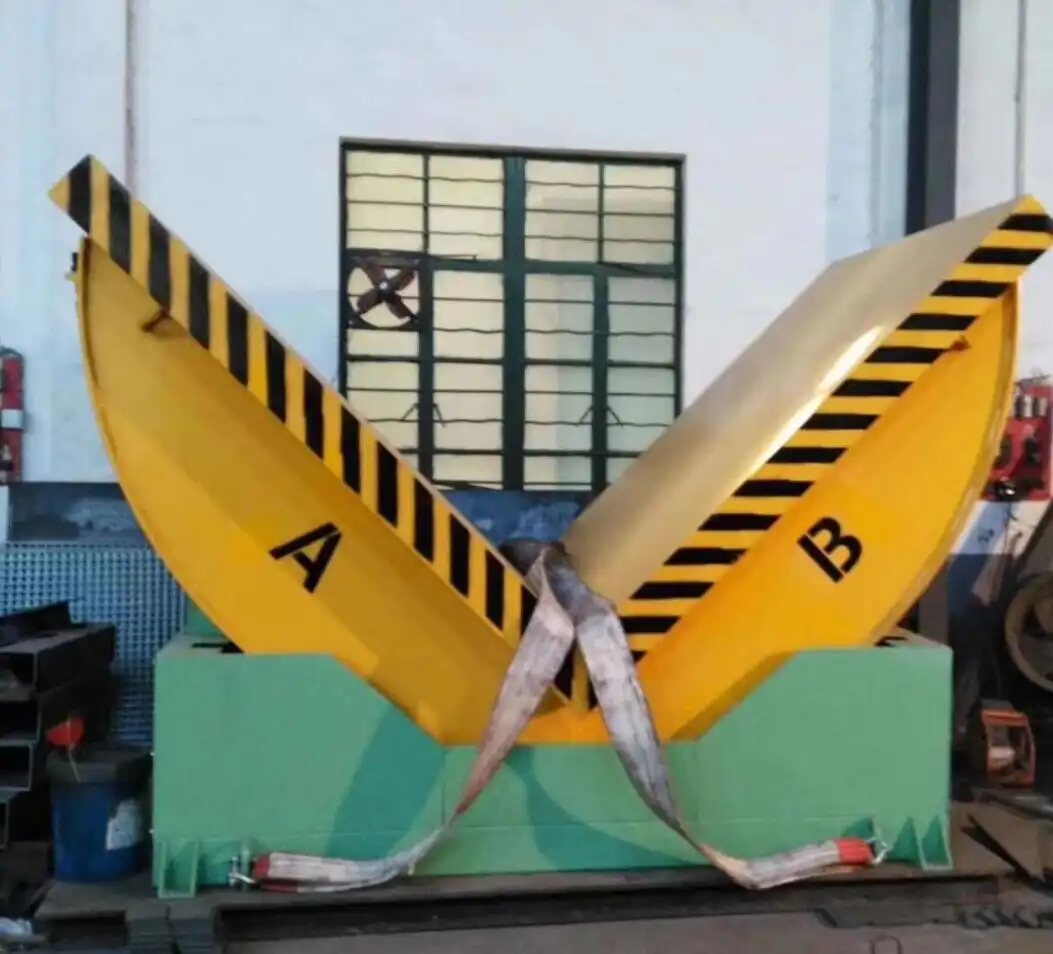
From my years working on factory floors and later building my own successful packing machine factory, I know that safety is not just a buzzword. It is a fundamental requirement. It is also good business. A single serious injury can cost a company millions in medical expenses, legal fees, lost productivity, and damaged morale. Michael's concern about "safety hazards" and "high injury risk" is completely valid. Coil upenders directly address these issues. They remove the human element from the point of highest risk. Workers no longer need to physically manipulate multi-ton coils. Instead, they can operate the machine from a safe distance, often with clear sightlines and intuitive controls. This transition from manual, high-risk tasks to automated, low-risk machine operation is one of the most compelling reasons to invest in an upender. It is an investment in your employees' well-being and your company's long-term stability. (Keywords: industrial safety features, heavy material handling safety, workplace accident prevention, automated factory safety)
Key Safety Features Integrated into Coil Upender Design
Modern coil upenders are built with safety as a primary design principle. Here are some standard and advanced features:
-
Emergency Stop (E-Stop) Buttons:
- 🛑 Function: Located at multiple accessible points around the machine and on the control panel.
- Benefit: Allows operators to immediately halt all machine movement in case of an emergency, preventing potential accidents.
-
Safety Interlocks and Guarding:
- 🔒 Function: Physical barriers, like safety fences or light curtains, prevent personnel from entering the machine's operating area during a cycle. Interlocks ensure the machine cannot start if a gate is open.
- Benefit: Creates a safe zone around the upender, protecting workers from moving parts and falling objects.
-
Overload Protection Systems:
- ⚖️ Function: Sensors and load cells monitor the weight of the coil. The machine will not operate or will stop if the load exceeds its rated capacity.
- Benefit: Prevents damage to the machine structure and motors, ensuring its longevity and preventing catastrophic failures due to excessive weight.
-
Anti-Slip Surfaces and Load Securing Mechanisms:
- 🛡️ Function: The coil platform often has textured, high-friction surfaces or mechanical clamps/stops. These features prevent the coil from sliding or rolling during rotation.
- Benefit: Ensures the coil remains stable and securely positioned throughout the entire tilting process, reducing the risk of the coil falling or shifting unexpectedly.
-
Controlled Speed and Smooth Acceleration/Deceleration:
- 🐢 Function: The machine operates with programmed acceleration and deceleration ramps. This avoids sudden jerks.
- Benefit: Minimizes dynamic forces on the coil and the machine. This reduces the risk of structural stress, product damage, and enhances overall operational safety.
-
Audible and Visual Alarms:
- 🔊 Function: Beacons, horns, or flashing lights activate during operation or in case of a fault.
- Benefit: Warns nearby personnel that the machine is in motion or requires attention, improving situational awareness on the factory floor.
These safety measures are not add-ons; they are integral to the design of a reliable coil upender. They provide peace of mind for managers like Michael. They ensure that operations continue without unnecessary risks or interruptions. Investing in such equipment is a clear commitment to a safer, more productive work environment. (Keywords: industrial safety equipment, hazard reduction in manufacturing, factory worker protection, heavy machinery safety standards)
4. How Do Coil Upenders Boost Your Production Efficiency and ROI?
Are your current coil handling methods creating costly bottlenecks, slowing down your entire production line? Is the manual labor involved in reorienting coils eating into your budget and reducing your overall profitability? Many companies face these challenges, leading to delayed deliveries, frustrated customers, and missed growth opportunities.
Coil upenders significantly boost production efficiency and deliver a strong return on investment (ROI) by automating a slow and labor-intensive process. They drastically reduce cycle times compared to manual methods, allowing for faster processing and increased throughput. By eliminating the need for multiple workers to physically handle heavy coils, upenders cut labor costs. They also minimize product damage that often occurs during manual handling, leading to fewer rejections and higher quality output. This combination of increased speed, reduced costs, and improved quality translates into clear financial benefits and a rapid ROI for your factory.
I have personally witnessed countless factories transform their operations after implementing automated packing and material handling solutions. My own journey from an employee to a factory owner taught me the direct correlation between efficient machinery and business growth. Michael's goals perfectly align with what an upender can achieve: "elevate automation level," "reduce costs and increase efficiency," and "seek professional guidance" for ROI-driven investments. Let's look at a typical scenario. If it takes three workers 15 minutes to manually and unsafely reorient a coil, an upender can do the same job with one operator in 2-3 minutes. This immediately frees up labor, reduces fatigue, and dramatically speeds up the flow of materials. This direct impact on efficiency is why a coil upender is not just an expense, but a strategic investment that pays for itself quickly. (Keywords: production line optimization, industrial automation ROI, factory cost reduction, material flow improvement)
Measuring the Impact: Efficiency Gains and Return on Investment
The benefits of a coil upender extend far beyond just turning a coil. They impact your bottom line directly.
-
Reduced Labor Costs:
- 💰 Impact: Eliminates the need for multiple workers to manually handle coils. One operator can manage the upender.
- Benefit: Frees up personnel for higher-value tasks, reducing overtime and overall labor expenses.
-
Increased Throughput and Speed:
- ⏱️ Impact: Automates a process that is slow and laborious when done manually. Upenders perform the task in minutes, not tens of minutes.
- Benefit: Dramatically reduces cycle times, speeding up the entire production line. This allows more coils to be processed in a given timeframe.
-
Minimized Product Damage:
- 📉 Impact: Controlled, smooth rotation prevents sudden drops or impacts that cause coil edge damage or surface scratches.
- Benefit: Reduces scrap rates, rejections, and customer complaints, leading to higher product quality and improved customer satisfaction.
-
Enhanced Workflow and Space Utilization:
- 📏 Impact: Streamlines the flow of materials by providing a consistent, predictable process for coil orientation.
- Benefit: Optimizes layout and reduces bottlenecks, making the overall factory operation smoother and potentially freeing up valuable floor space.
-
Improved Employee Morale and Safety:
- 😊 Impact: Reduces the physical strain and risk of injury for workers.
- Benefit: Creates a safer work environment. This leads to happier employees, lower absenteeism, and reduced insurance costs.
Example ROI Calculation (Simplified)
Let's consider Michael's factory.
| Factor | Current Manual Process | Automated Upender Process | Annual Savings |
|---|---|---|---|
| Labor Cost (per coil) | 3 workers * 15 min * $20/hr = $15 | 1 worker * 3 min * $20/hr = $1 | $14/coil |
| Coils Processed/Day | 30 coils (due to bottlenecks) | 150 coils (increased speed) | 120 extra coils |
| Product Damage | $50/coil (due to mishandling) | $5/coil (negligible) | $45/coil |
| Total Daily Savings | ($14 + $45) * 150 coils + $14*30 = $8820 | ||
| Annual Savings | (assuming 250 working days) | ~$2,205,000 | |
| Upender Cost | $150,000 - $300,000 (estimation) | ||
| ROI Period | ~1-3 months (depending on specific model) |
Please note: These figures are illustrative. Actual ROI will vary based on specific factory conditions, labor rates, and upender model.
The return on investment for a coil upender is often very quick. This is especially true for factories with high production volumes. The combined savings from reduced labor, decreased product damage, and increased output quickly offset the initial equipment cost. This makes it a sound financial decision. It is an investment in streamlined operations and long-term profitability. (Keywords: ROI analysis industrial equipment, manufacturing cost-benefit, automated production line, factory efficiency metrics)
Conclusion
Coil upenders are essential machines that enhance safety and efficiency in heavy coil handling. They automate risky tasks and boost throughput, providing clear ROI. For robust and reliable solutions, consider industry leaders in steel coil packing line technology.